
📄️Research Diary
18. London Design Festival exhibition
In this exhibition, I presented some of my works developed at Walthamstow Wetlands, including structural score pieces and sound sculptures. Although they are still provisional outcomes and based on preliminary experiments in test sites, I generated images to visualise the effects I hope to achieve in the final exhibition at the end of the year.
The structural score work, Resonance of Walthamstow Wetlands: Scorescapes, was displayed within white frames to highlight its symbolic qualities, while the imagery breaks out of the frame’s boundaries, extending beyond the space.
For the sound sculpture piece, Resonance of Walthamstow Wetlands: Soundscapes, my plan is to show it with a combination of floor stands, contact microphones, and speakers. At this stage, the sculpture still retains a form without any surface attachments, emphasising the textures on the surface of the disc-sculpture itself. How to make its sound perceptible is another question I am considering: it could be through a “record player” mode, through simple suspension or mounted display, or by using scanning technologies to create a digital symbolic landscape.
——
Resonance of Walthamstow Wetlands forms part of my doctoral research, which investigates the symbolic and acoustic entanglements of human intervention and ecological vitality within urbanised environments. The work unfolds in two parts: Scorescapes captures on-site perception and soundscape experience by transcribing the wetlands’ structures into musical notation, translating ecological resonance into visual symbols; while Soundscapes materialises these interactions through a cast record-sculpture, where the interplay of industry and nature becomes a tactile and audible object.
Together, these works are not simply representations of the urban wetlands’ unique frequencies, but experiments in shaping sound as an “ecological language.” Through the dual practices of notation and casting, I seek to transform soundscapes into tangible ecosymbols, extending the limits of musical notation and proposing modes of resonance that move beyond human-centred perception.
In this exhibition, I presented some of my works developed at Walthamstow Wetlands, including structural score pieces and sound sculptures. Although they are still provisional outcomes and based on preliminary experiments in test sites, I generated images to visualise the effects I hope to achieve in the final exhibition at the end of the year.
The structural score work, Resonance of Walthamstow Wetlands: Scorescapes, was displayed within white frames to highlight its symbolic qualities, while the imagery breaks out of the frame’s boundaries, extending beyond the space.
For the sound sculpture piece, Resonance of Walthamstow Wetlands: Soundscapes, my plan is to show it with a combination of floor stands, contact microphones, and speakers. At this stage, the sculpture still retains a form without any surface attachments, emphasising the textures on the surface of the disc-sculpture itself. How to make its sound perceptible is another question I am considering: it could be through a “record player” mode, through simple suspension or mounted display, or by using scanning technologies to create a digital symbolic landscape.
——
Resonance of Walthamstow Wetlands forms part of my doctoral research, which investigates the symbolic and acoustic entanglements of human intervention and ecological vitality within urbanised environments. The work unfolds in two parts: Scorescapes captures on-site perception and soundscape experience by transcribing the wetlands’ structures into musical notation, translating ecological resonance into visual symbols; while Soundscapes materialises these interactions through a cast record-sculpture, where the interplay of industry and nature becomes a tactile and audible object.
Together, these works are not simply representations of the urban wetlands’ unique frequencies, but experiments in shaping sound as an “ecological language.” Through the dual practices of notation and casting, I seek to transform soundscapes into tangible ecosymbols, extending the limits of musical notation and proposing modes of resonance that move beyond human-centred perception.
17.
2025/6/24-7/1 Casting
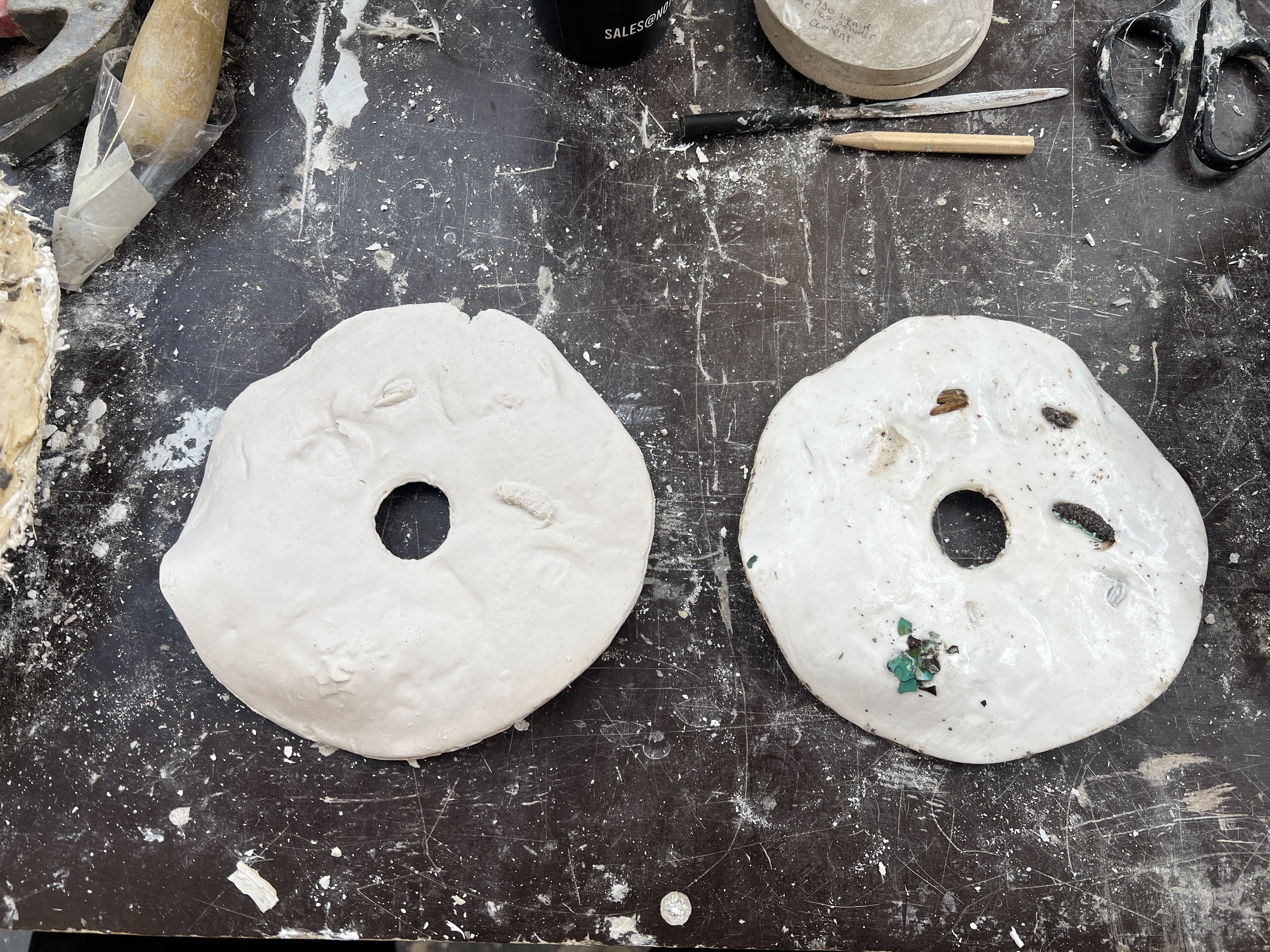
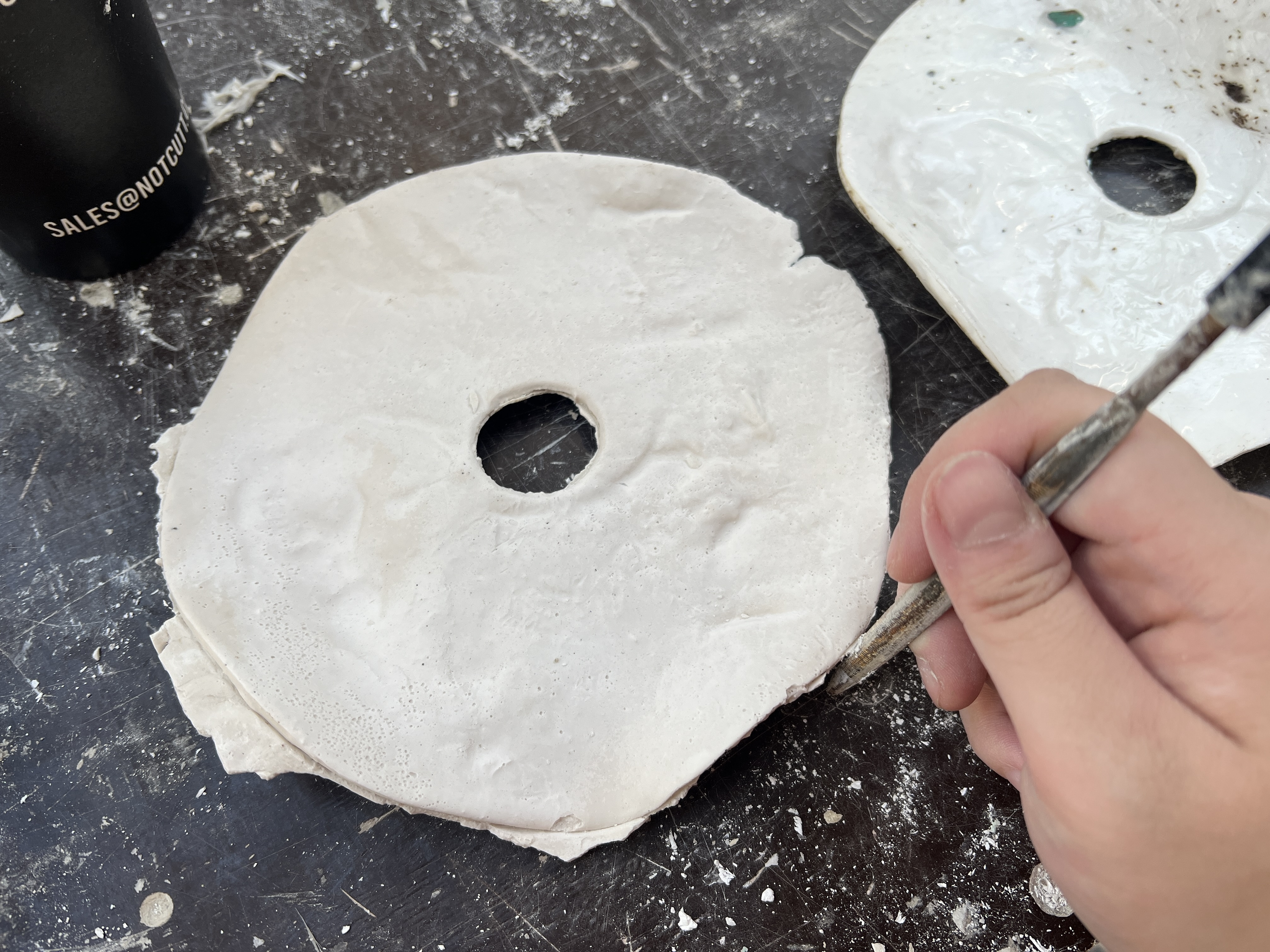
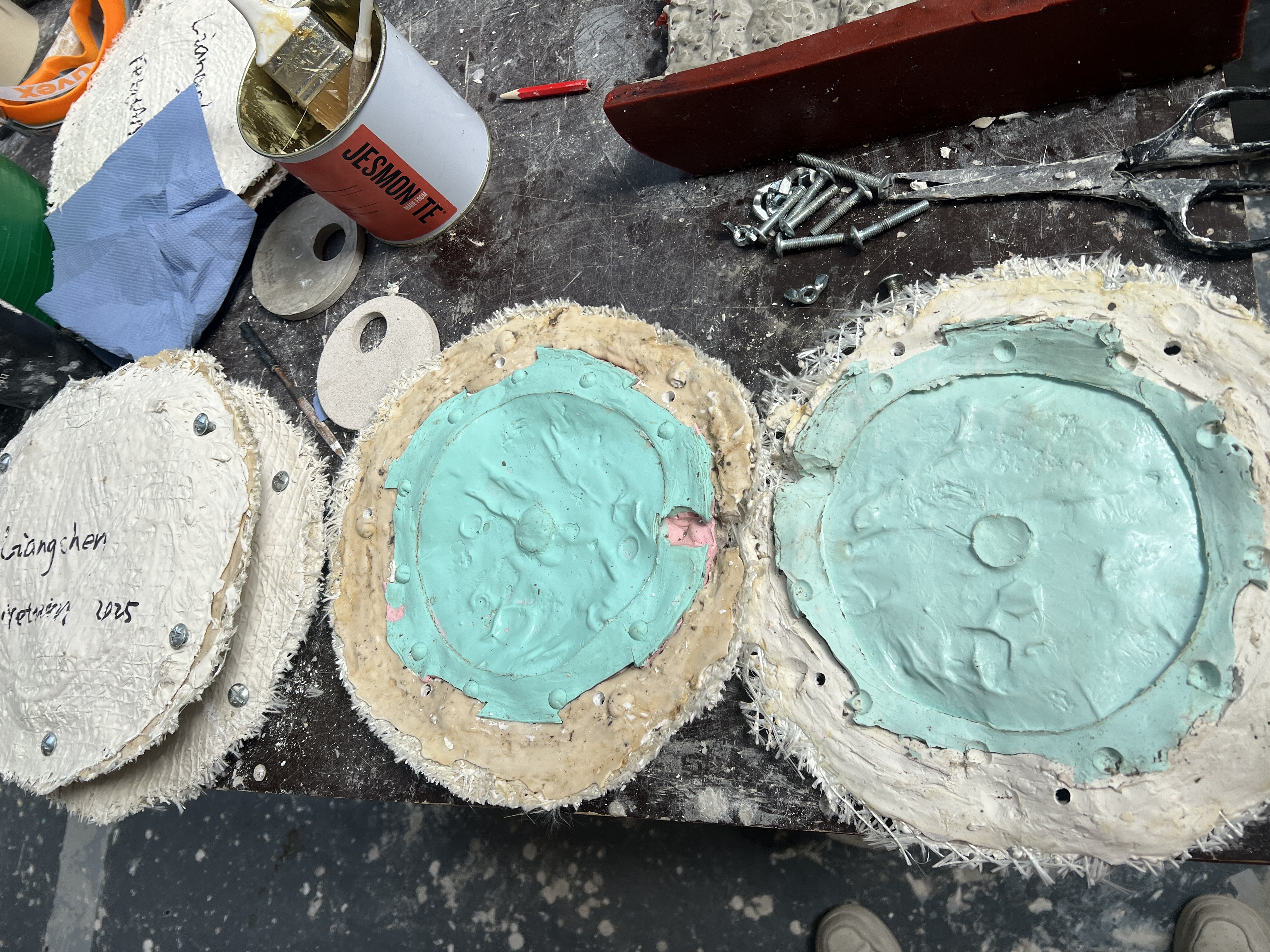
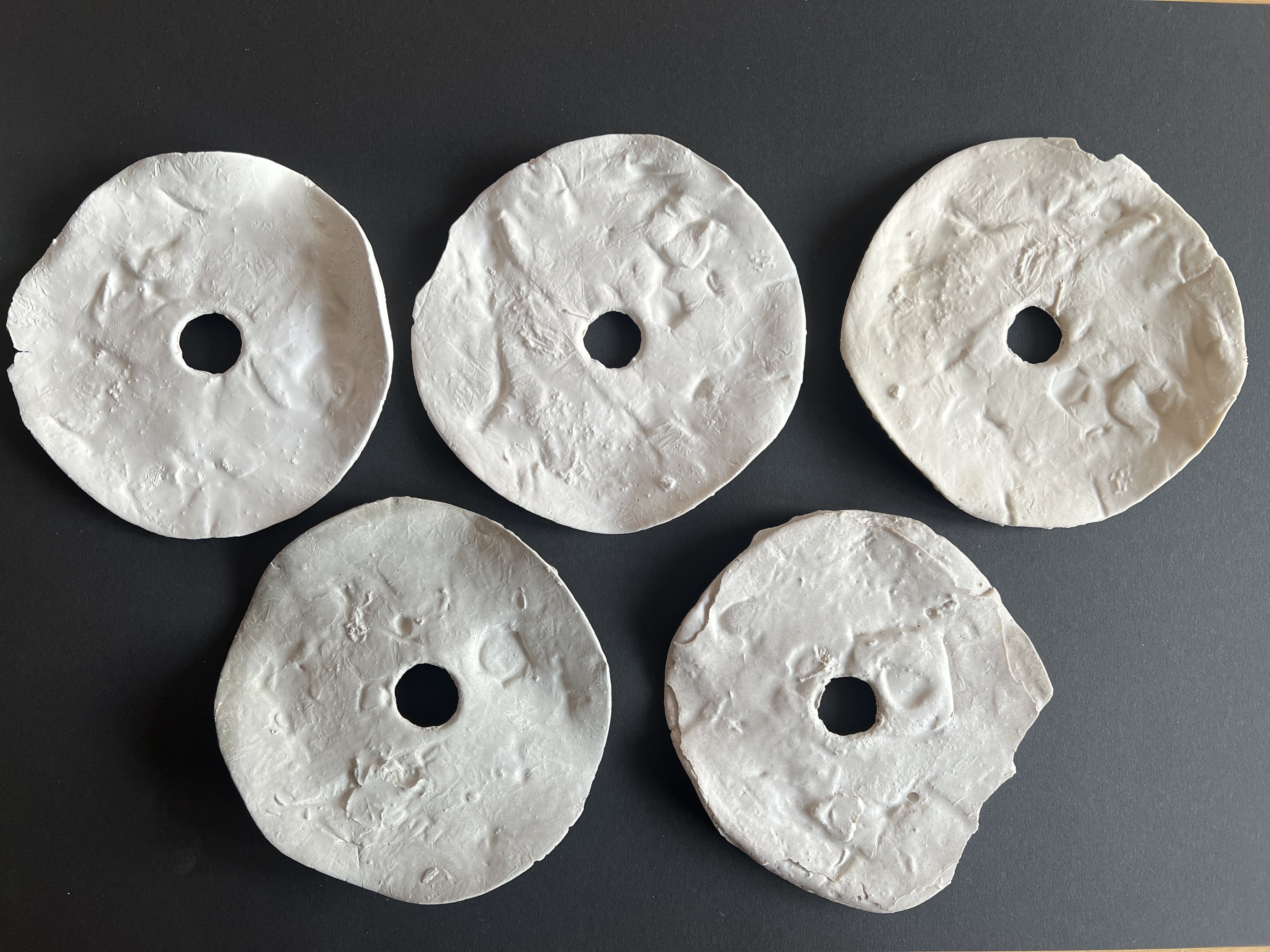
During this period, I completed six full castings of sculptures based on the soundscapes of Walthamstow Wetlands. If the process proves successful, I am considering making several sculpture moulds from the Yellow River Delta wetlands as well. Although it is time-consuming, labour-intensive, and costly, I may need to upgrade the process or change materials in the future—for example, once the forms are determined, I could use single-use moulds to save costs.
I’ve tested several materials and textures:
• Plaster: The texture comes out very clear, it feels nice and light, but it’s quite fragile and scratches easily. The sound it produces is crisp.
• Strength Plaster: This looks clean and has a good texture too, similar to regular plaster but stronger and heavier. It doesn’t scratch as easily, and the sound is still pretty crisp.
• Cement: This looks more like concrete or stone, giving it a stronger industrial feel. It’s a bit fragile, but the texture is clear. It’s heavier than plaster, and the sound is bright and crisp.
• To compare plaster and cement with something less fragile, I tried two kinds of Jesmonite: one pure Jesmonite, and one mixed with Portland stone, which looks more like a natural sandy stone texture. Although these are quite sturdy/strong, their downside is that they’re heavy, so the texture detail isn’t as clear, and the sound is unclear/dull and muffled.
For the material tests, I focused on two main points: Retaining the accuracy of the texture and the audibility of the material.
I also did a sound test and assembled the DIY mode — you can hear the different materials vibrating and producing sound through friction (amplified by contact microphone and amplifier). Some materials sound crisp and bright, others are deeper and muffled. My first choice would be plaster or cement because of their better audibility.
What I’m thinking is not just to show these as static sculptures, but to present them as sound installations. The idea is to use the mechanism of a turntable, which turns and friction with a stylus, and amplifies the sound using contact microphones. So the textures on the surface of each record would be read sonically/audibly. I want to have around ten or more records playing at the same time, creating a new kind of soundscape in the exhibition space— one that reinterprets and reactivates/reproduces the industrial sound memory of both wetland sites. It’s not just about the vitality of sound, but also about the record as a carrier of landscape, memory, and sonic symbols. The way the texture generates sound through friction and vibration becomes a way of exploring how symbols can be transformed back into sound — a kind of material sonification. So the installation becomes both a sonic archive and a symbolic translation — giving voice to the ecological tension zones I’ve been working with.
In addition, I have been considering whether to use the original models (made with air-dry clay and carrying attached collected materials). These pieces, with their varied forms, embody the specific features of each site. For the harder material sculptures that function as sound installations, I could also experiment with attaching collected materials and coating them with resin.
While working on these sculptures at the sites, I keep thinking about the meaning of their textures—what they signify, and how they might carry traces of the place. I want to continue testing different materials, searching for a methodology of sound symbols, and eventually forming objects that embody the soundscape in symbolic ways.
I also wonder about the linguistic or non-linguistic dimensions of these works. Could they be abstracted into something not intended only for human perception, but perhaps for outer space, for aliens, or for certain nonhuman beings to experience?
During this period, I completed six full castings of sculptures based on the soundscapes of Walthamstow Wetlands. If the process proves successful, I am considering making several sculpture moulds from the Yellow River Delta wetlands as well. Although it is time-consuming, labour-intensive, and costly, I may need to upgrade the process or change materials in the future—for example, once the forms are determined, I could use single-use moulds to save costs.
I’ve tested several materials and textures:
• Plaster: The texture comes out very clear, it feels nice and light, but it’s quite fragile and scratches easily. The sound it produces is crisp.
• Strength Plaster: This looks clean and has a good texture too, similar to regular plaster but stronger and heavier. It doesn’t scratch as easily, and the sound is still pretty crisp.
• Cement: This looks more like concrete or stone, giving it a stronger industrial feel. It’s a bit fragile, but the texture is clear. It’s heavier than plaster, and the sound is bright and crisp.
• To compare plaster and cement with something less fragile, I tried two kinds of Jesmonite: one pure Jesmonite, and one mixed with Portland stone, which looks more like a natural sandy stone texture. Although these are quite sturdy/strong, their downside is that they’re heavy, so the texture detail isn’t as clear, and the sound is unclear/dull and muffled.
For the material tests, I focused on two main points: Retaining the accuracy of the texture and the audibility of the material.
I also did a sound test and assembled the DIY mode — you can hear the different materials vibrating and producing sound through friction (amplified by contact microphone and amplifier). Some materials sound crisp and bright, others are deeper and muffled. My first choice would be plaster or cement because of their better audibility.
What I’m thinking is not just to show these as static sculptures, but to present them as sound installations. The idea is to use the mechanism of a turntable, which turns and friction with a stylus, and amplifies the sound using contact microphones. So the textures on the surface of each record would be read sonically/audibly. I want to have around ten or more records playing at the same time, creating a new kind of soundscape in the exhibition space— one that reinterprets and reactivates/reproduces the industrial sound memory of both wetland sites. It’s not just about the vitality of sound, but also about the record as a carrier of landscape, memory, and sonic symbols. The way the texture generates sound through friction and vibration becomes a way of exploring how symbols can be transformed back into sound — a kind of material sonification. So the installation becomes both a sonic archive and a symbolic translation — giving voice to the ecological tension zones I’ve been working with.
In addition, I have been considering whether to use the original models (made with air-dry clay and carrying attached collected materials). These pieces, with their varied forms, embody the specific features of each site. For the harder material sculptures that function as sound installations, I could also experiment with attaching collected materials and coating them with resin.
While working on these sculptures at the sites, I keep thinking about the meaning of their textures—what they signify, and how they might carry traces of the place. I want to continue testing different materials, searching for a methodology of sound symbols, and eventually forming objects that embody the soundscape in symbolic ways.
I also wonder about the linguistic or non-linguistic dimensions of these works. Could they be abstracted into something not intended only for human perception, but perhaps for outer space, for aliens, or for certain nonhuman beings to experience?
16.
2025/5/24
To gather more material before the end of my initial residency at the Yellow River Delta wetlands, I returned to the oil extraction area near the lakes and wetland lagoons I had visited before. I specifically sought out a pump jack at the edge of the site to carefully record the sounds inside its machinery. I inserted a microphone into its openings and also attached contact microphone patches onto its surface to listen to its internal vibrations.
I stayed at the same spot for quite a while, patiently listening, and gradually began to hear an intriguing rhythm emerge from the noise. This unexpected discovery was truly exciting. I tried several times to capture it, though my ears on site were far more sensitive to this rhythm than the recorder was—the recordings often contained more interference, sometimes drowning out the rhythmic sound I had noticed.
That rhythm, however fragile, felt like more than a mechanical by-product. It reminded me of my own attempts in sound sculpture, where textures, grooves, and surfaces transform into sonic patterns. The pump jack’s hidden rhythm seemed almost to carve itself into the air, much like how I cast textures into sculpture surfaces. I began to wonder whether these industrial beats could be translated into symbols—notations that embody the entanglement of machine and environment. Perhaps what I heard was not just noise but a trace of industrial vitality, a kind of accidental score waiting to be materialised into the language of ecosound notation.
To gather more material before the end of my initial residency at the Yellow River Delta wetlands, I returned to the oil extraction area near the lakes and wetland lagoons I had visited before. I specifically sought out a pump jack at the edge of the site to carefully record the sounds inside its machinery. I inserted a microphone into its openings and also attached contact microphone patches onto its surface to listen to its internal vibrations.
I stayed at the same spot for quite a while, patiently listening, and gradually began to hear an intriguing rhythm emerge from the noise. This unexpected discovery was truly exciting. I tried several times to capture it, though my ears on site were far more sensitive to this rhythm than the recorder was—the recordings often contained more interference, sometimes drowning out the rhythmic sound I had noticed.
That rhythm, however fragile, felt like more than a mechanical by-product. It reminded me of my own attempts in sound sculpture, where textures, grooves, and surfaces transform into sonic patterns. The pump jack’s hidden rhythm seemed almost to carve itself into the air, much like how I cast textures into sculpture surfaces. I began to wonder whether these industrial beats could be translated into symbols—notations that embody the entanglement of machine and environment. Perhaps what I heard was not just noise but a trace of industrial vitality, a kind of accidental score waiting to be materialised into the language of ecosound notation.
15.
2025/5/21
At the urban–rural edge of the wetland lake area, I followed the path along a small river, slowly approaching a dense cluster of pump jacks. This was an oil extraction site belonging to a company division, with workers coming and going as production continued. On the opposite side of the river, I searched along the stranded riverbank—on the uneven, mottled sand and gravel, traces of industry were exposed. Around here, utility poles were especially numerous. Beside a massive high-voltage tower, I crouched down to record the sound of the flowing water with a contact microphone, as well as the sounds within the water itself (though the underwater sounds were unclear due to equipment limitations). Interwoven with the water’s flow were the sounds of pump jacks across the river and the hum of the high-voltage structure.
Afterwards, I crossed to the other side, into the cluster of pump jacks. The closer I got, the rougher the dirt road became, and the vehicle jolted up and down. I stopped by a pump jack next to a lake, where a flock of white birds was calling brightly as they hovered above the water. The wind was strong that day, yet at times their calls rose above the rush of the wind. At the lakeside, two old-style pump jacks were nodding rhythmically in turn. What intrigued me most was seeing, for the first time, several sparrows alighting on the pump jacks—especially along the horizontal power line. They balanced perfectly with the machine’s movement, as if the roar of the machinery hardly affected them.
This image stayed with me: birds perching on machines, their fragile bodies in rhythm with industrial motion, their voices momentarily rising above both wind and mechanical roar. The sparrows and pump jacks formed a strange ensemble, a soundscape where ecological and mechanical energies are inseparable.
At the urban–rural edge of the wetland lake area, I followed the path along a small river, slowly approaching a dense cluster of pump jacks. This was an oil extraction site belonging to a company division, with workers coming and going as production continued. On the opposite side of the river, I searched along the stranded riverbank—on the uneven, mottled sand and gravel, traces of industry were exposed. Around here, utility poles were especially numerous. Beside a massive high-voltage tower, I crouched down to record the sound of the flowing water with a contact microphone, as well as the sounds within the water itself (though the underwater sounds were unclear due to equipment limitations). Interwoven with the water’s flow were the sounds of pump jacks across the river and the hum of the high-voltage structure.
Afterwards, I crossed to the other side, into the cluster of pump jacks. The closer I got, the rougher the dirt road became, and the vehicle jolted up and down. I stopped by a pump jack next to a lake, where a flock of white birds was calling brightly as they hovered above the water. The wind was strong that day, yet at times their calls rose above the rush of the wind. At the lakeside, two old-style pump jacks were nodding rhythmically in turn. What intrigued me most was seeing, for the first time, several sparrows alighting on the pump jacks—especially along the horizontal power line. They balanced perfectly with the machine’s movement, as if the roar of the machinery hardly affected them.
This image stayed with me: birds perching on machines, their fragile bodies in rhythm with industrial motion, their voices momentarily rising above both wind and mechanical roar. The sparrows and pump jacks formed a strange ensemble, a soundscape where ecological and mechanical energies are inseparable.
14. 2025/5/18
To record more sounds of pump jacks, collect more textures through frottage, and search for more sites to create sound sculpture models, I went to a stretch of wetland wilderness at the urban–rural edge. Passing through a factory and climbing over a fence, I walked along the uneven dirt road straight toward a cluster of pump jacks in the distance.
Here, old and new pump jacks stood side by side, forming an intriguing scene—perhaps even a miniature of technological transformation. The old-style pump jacks nodded up and down with loud noise, while the newer ones moved vertically with a smaller amplitude, occupying less space and producing a slightly softer mechanical sound.
In this desolate area, I was able to approach the pump jacks closely. Beside them stood a small building filled with pipes and pumps, and yellow fences enclosed a covered, abandoned wellhead. Everything here appeared weathered and mottled, yet the tyre tracks across the ground revealed that these pump jacks were still in operation and under supervision.
To record more sounds of pump jacks, collect more textures through frottage, and search for more sites to create sound sculpture models, I went to a stretch of wetland wilderness at the urban–rural edge. Passing through a factory and climbing over a fence, I walked along the uneven dirt road straight toward a cluster of pump jacks in the distance.
Here, old and new pump jacks stood side by side, forming an intriguing scene—perhaps even a miniature of technological transformation. The old-style pump jacks nodded up and down with loud noise, while the newer ones moved vertically with a smaller amplitude, occupying less space and producing a slightly softer mechanical sound.
In this desolate area, I was able to approach the pump jacks closely. Beside them stood a small building filled with pipes and pumps, and yellow fences enclosed a covered, abandoned wellhead. Everything here appeared weathered and mottled, yet the tyre tracks across the ground revealed that these pump jacks were still in operation and under supervision.
13. 2025/5/11 The Battle of Gudong: The East Dong Sea Dyke and Predatory Extraction — a large cluster of pumpjacks all facing east
The Gudong Campaign was a large-scale oil development operation launched in 1986 by China’s Ministry of Petroleum Industry and organised by the Shengli Oilfield. The campaign officially began on March 21, 1986, mobilising 15,000 oilfield workers and 18,000 migrant labourers, along with 55 drilling rigs in a coordinated group operation. Under the slogan "Work hard for 100 days, no Sundays off, the campaign aimed to drill 300 wells and reach a daily crude oil output of over 10,000 tons within just over three months. By the end of the year, the campaign had completed 794 drillings, with 783 wells put into production, yielding a total of 3.238 million tons of crude oil[1].
Green Transition: In 2025, silent pumpjacks were introduced to reduce noise pollution, along with a giraffe-shaped pumpjack designed as a city landmark. These smart pumpjacks use data collection and automation to boost efficiency, automatically adjusting balance while cutting construction costs and shortening build time. [2]
[1] https://baike.baidu.com/item/%E5%AD%A4%E4%B8%9C%E4%BC%9A%E6%88%98/15384729
[2] https://baijiahao.baidu.com/s?id=1834138055967905965&wfr=spider&for=pc
The Gudong Campaign was a large-scale oil development operation launched in 1986 by China’s Ministry of Petroleum Industry and organised by the Shengli Oilfield. The campaign officially began on March 21, 1986, mobilising 15,000 oilfield workers and 18,000 migrant labourers, along with 55 drilling rigs in a coordinated group operation. Under the slogan "Work hard for 100 days, no Sundays off, the campaign aimed to drill 300 wells and reach a daily crude oil output of over 10,000 tons within just over three months. By the end of the year, the campaign had completed 794 drillings, with 783 wells put into production, yielding a total of 3.238 million tons of crude oil[1].
Green Transition: In 2025, silent pumpjacks were introduced to reduce noise pollution, along with a giraffe-shaped pumpjack designed as a city landmark. These smart pumpjacks use data collection and automation to boost efficiency, automatically adjusting balance while cutting construction costs and shortening build time. [2]
[1] https://baike.baidu.com/item/%E5%AD%A4%E4%B8%9C%E4%BC%9A%E6%88%98/15384729
[2] https://baijiahao.baidu.com/s?id=1834138055967905965&wfr=spider&for=pc
12. 2025/5/9
Self-driving survey around the wetlands
The weather this time was really rough—strong winds mixed with rain, it felt like it might blow me away. But since this was a rare chance to drive myself into the park for field research, I had to push through despite the conditions. I drove in with my mom, my aunt, my cousin, and my little nephew. After a lot of coordination, we finally got permission to drive inside the Yellow River Estuary Ecotourism Zone ourselves, which meant we could control the route and timing on our own.
As soon as we entered the park, we headed straight to a restricted area for visitors—a seaside dock with a long stone breakwater stretching into the sea. It looked abandoned for a long time. The dock was fenced off with sharp steel cables, and nearby stood a small monitoring device marked with the Dongying Natural Resources and Planning Bureau. Around it, the deep yellow muddy seawater splashed against the rocky shore. Dongying’s coastline doesn’t really have clean, soft sandy beaches. It’s mostly mudflats or rocky shores. Years ago, some of the beaches were seriously polluted; people often say the oil pollution here makes it unsuitable for tourism. Leaning near the water’s edge, I recorded the murky waves and the roaring sea wind with my recorder. I could also hear the sound of dry reed stalks swaying in the wind, but then rain suddenly started falling and drowned out all other sounds. On the shallow green flats and marshes stood various birds, with some circling overhead—Little Ringed Plovers, Sparrowhawks, Black-capped Kingfishers, and Eurasian Woodcocks—calling out with short and long cries. At first glance, I thought the dark patches blending into the shallow marsh were just stones, but looking closer, I saw they were huge flocks of birds. Some were hiding in the red-tinted vegetation just starting to poke through. It wasn’t easy to spot them. The roadside reeds and invasive cordgrass whipped wildly in the strong wind. I followed along, recording bird songs, and was delighted to see two Oriental Storks suddenly fly out of the reeds nearby. Their calls were strange—deep and powerful, strikingly different from the other sharp bird sounds around.
I spent a little more time soundwalking in the light rain, looking around. This season, the coastal wetland hadn’t yet revealed its famous red vegetation landscape. They say in autumn and winter, it looks like a “red carpet” spread across the land. According to research, this wetland is the world’s most intact and youngest temperate saline-alkaline ecosystem, covering about 5,000 square kilometres. It’s home to vast salt flats and native plants like Suaeda salsa (saltwort). In autumn, the Suaeda turns from green to red, blending with reeds and sea grasses[1] to create a vibrant, colourful “red carpet” scene[2].
We drove into the industrial zone, and I randomly picked a pumpjack fairly close to where the birds had been gathering earlier. The sound it made was deafening. Standing near it, the clanking of metal and the whirring machinery completely drowned out the bird calls I had just been listening to. Even though I didn’t get right up against it, I could still feel the mechanical vibrations through the ground beneath my feet. Looking around, there were no birds anywhere within several dozen meters of the machine. It wasn’t fenced off either. The base sat on swampy ground with dried mud patterns, water marks on the surface, and some half-buried dead plant branches. I could almost imagine how this spot had once blended seamlessly with the surrounding wetlands, but the pumpjack’s installation carved out a bare patch of land all on its own. Maybe the workers kept the area clear, or when they built it they removed all the plants and roots. Or perhaps the soil around the machine was contaminated, making it impossible for anything to grow. I was surprised that not a single blade of grass grew on that patch. This was my first time being so close to a pumpjack—only about two meters away—and I studied it carefully. Though I grew up in an oil town and had seen countless pumpjacks, they’re usually fenced off for safety, so it was the first time I saw one so exposed in the wetland park. Safety was still my top priority, so without any barriers, I kept a safe distance while observing. After leaving the factory, we explored some little paths that are barely seenby people. But all of them were dead ends, and we had to turn back each time. Deep in the park, a few wild pheasants ran around freely.
Before leaving the park, I visited the “Huang He San Jiao Zhou Bird Museum” inside the reserve — a national level-two museum and one of China’s largest bird[3]-focused museums. It’s a newly constructed building with heavy investment from the city government, covering about 3,000 square meters of exhibition space[4]. Inside, huge screens showed videos of the wetland’s natural scenery. Information panels, murals, and specimen models shared rich knowledge about the nature reserve — covering biodiversity, bird and plant species, bird migration, conservation management, ecological restoration, and more. The museum is clearly designed with strong educational goals. But the souvenir shop at the exit was a bit disappointing — lacking creativity and artistic touch. That actually sparked my desire to collaborate and bring something fresh to that space.
On the way back, heavy rain poured down nonstop. The windshield wipers swung back and forth, but the glass fogged up inside the car. The fast, hard rain hammered against the windows, blurring my view. The road was empty — no one else around. Swallows and sparrows flew low, and as the car got close, it felt like we almost hit them. But they were quick and darted away just in time. It kept giving me a bit of a thrill every time.
[1] https://baijiahao.baidu.com/s?id=1833137202046026328&wfr=spider&for=pc
[2] https://baijiahao.baidu.com/s?id=1812622061622389609&wfr=spider&for=pc
[3] https://m.thepaper.cn/newsDetail_forward_25459640
[4] https://www.sohu.com/a/901314399_121106991
The weather this time was really rough—strong winds mixed with rain, it felt like it might blow me away. But since this was a rare chance to drive myself into the park for field research, I had to push through despite the conditions. I drove in with my mom, my aunt, my cousin, and my little nephew. After a lot of coordination, we finally got permission to drive inside the Yellow River Estuary Ecotourism Zone ourselves, which meant we could control the route and timing on our own.
As soon as we entered the park, we headed straight to a restricted area for visitors—a seaside dock with a long stone breakwater stretching into the sea. It looked abandoned for a long time. The dock was fenced off with sharp steel cables, and nearby stood a small monitoring device marked with the Dongying Natural Resources and Planning Bureau. Around it, the deep yellow muddy seawater splashed against the rocky shore. Dongying’s coastline doesn’t really have clean, soft sandy beaches. It’s mostly mudflats or rocky shores. Years ago, some of the beaches were seriously polluted; people often say the oil pollution here makes it unsuitable for tourism. Leaning near the water’s edge, I recorded the murky waves and the roaring sea wind with my recorder. I could also hear the sound of dry reed stalks swaying in the wind, but then rain suddenly started falling and drowned out all other sounds. On the shallow green flats and marshes stood various birds, with some circling overhead—Little Ringed Plovers, Sparrowhawks, Black-capped Kingfishers, and Eurasian Woodcocks—calling out with short and long cries. At first glance, I thought the dark patches blending into the shallow marsh were just stones, but looking closer, I saw they were huge flocks of birds. Some were hiding in the red-tinted vegetation just starting to poke through. It wasn’t easy to spot them. The roadside reeds and invasive cordgrass whipped wildly in the strong wind. I followed along, recording bird songs, and was delighted to see two Oriental Storks suddenly fly out of the reeds nearby. Their calls were strange—deep and powerful, strikingly different from the other sharp bird sounds around.
I spent a little more time soundwalking in the light rain, looking around. This season, the coastal wetland hadn’t yet revealed its famous red vegetation landscape. They say in autumn and winter, it looks like a “red carpet” spread across the land. According to research, this wetland is the world’s most intact and youngest temperate saline-alkaline ecosystem, covering about 5,000 square kilometres. It’s home to vast salt flats and native plants like Suaeda salsa (saltwort). In autumn, the Suaeda turns from green to red, blending with reeds and sea grasses[1] to create a vibrant, colourful “red carpet” scene[2].
We drove into the industrial zone, and I randomly picked a pumpjack fairly close to where the birds had been gathering earlier. The sound it made was deafening. Standing near it, the clanking of metal and the whirring machinery completely drowned out the bird calls I had just been listening to. Even though I didn’t get right up against it, I could still feel the mechanical vibrations through the ground beneath my feet. Looking around, there were no birds anywhere within several dozen meters of the machine. It wasn’t fenced off either. The base sat on swampy ground with dried mud patterns, water marks on the surface, and some half-buried dead plant branches. I could almost imagine how this spot had once blended seamlessly with the surrounding wetlands, but the pumpjack’s installation carved out a bare patch of land all on its own. Maybe the workers kept the area clear, or when they built it they removed all the plants and roots. Or perhaps the soil around the machine was contaminated, making it impossible for anything to grow. I was surprised that not a single blade of grass grew on that patch. This was my first time being so close to a pumpjack—only about two meters away—and I studied it carefully. Though I grew up in an oil town and had seen countless pumpjacks, they’re usually fenced off for safety, so it was the first time I saw one so exposed in the wetland park. Safety was still my top priority, so without any barriers, I kept a safe distance while observing. After leaving the factory, we explored some little paths that are barely seenby people. But all of them were dead ends, and we had to turn back each time. Deep in the park, a few wild pheasants ran around freely.
Before leaving the park, I visited the “Huang He San Jiao Zhou Bird Museum” inside the reserve — a national level-two museum and one of China’s largest bird[3]-focused museums. It’s a newly constructed building with heavy investment from the city government, covering about 3,000 square meters of exhibition space[4]. Inside, huge screens showed videos of the wetland’s natural scenery. Information panels, murals, and specimen models shared rich knowledge about the nature reserve — covering biodiversity, bird and plant species, bird migration, conservation management, ecological restoration, and more. The museum is clearly designed with strong educational goals. But the souvenir shop at the exit was a bit disappointing — lacking creativity and artistic touch. That actually sparked my desire to collaborate and bring something fresh to that space.
On the way back, heavy rain poured down nonstop. The windshield wipers swung back and forth, but the glass fogged up inside the car. The fast, hard rain hammered against the windows, blurring my view. The road was empty — no one else around. Swallows and sparrows flew low, and as the car got close, it felt like we almost hit them. But they were quick and darted away just in time. It kept giving me a bit of a thrill every time.
[1] https://baijiahao.baidu.com/s?id=1833137202046026328&wfr=spider&for=pc
[2] https://baijiahao.baidu.com/s?id=1812622061622389609&wfr=spider&for=pc
[3] https://m.thepaper.cn/newsDetail_forward_25459640
[4] https://www.sohu.com/a/901314399_121106991
11.2025/5/1-6
abC Exhibition and Workshop Notes
The art fair lasted for five days, and it was really intense (very busy throughout). But it was a valuable experience for me. I presented a range of visual works at my booth, and all the graphic elements were based on nonhuman subjects, so there was a strong topic connection to my research. There were thousands of visitors each day.
I used this tablet to show two of my experimental sound videos. One was my earlier piece, City of Scars, and the other was a draft of Variations on Birdsongs, which I created during my wetland fieldwork based on birdsong. I invited visitors to listen, and I was surprised by how many people engaged with it closely — I received at least 30 meaningful pieces of feedback. This experience really gave me more confidence to push forward with future outputs, especially those more directly related to music experiments like concrete music.
I also printed out some of my experimental scores and put them up on the wall as part of the display. I even made some into bookmarks to sell. It turned out to be a really good way to start conversations with people — I explained the ideas behind the scores and how they relate to my research. Quite a few visitors were really interested, and their responses gave me a lot of encouragement. It made me feel more confident about the direction I’m going in, especially in terms of making the visual scores more public and thinking further about how they might connect with ecology and sound performance.
The workshop went really well — it was such a valuable experience! Because this was a national art festival, so the participants came from all over China and had quite diverse backgrounds. Some were ecology students or art students, while others were professional musicians or artists. My aim was to unpack and test some of the methodologies I've been developing — like deep listening, soundwalking, improvisation and participatory art. Most importantly, I wanted to explore how participants would generate ecosound notation and then express those symbols using sound-based media/instruments. So it became a kind of multi-layered transformation — from sound to symbol, and back to sound again.
The workshop followed the planned structure and was divided into two main parts — outside and inside sessions. I asked participants to sign the consent form beforehand, so I had their permission to include their input in my research. They were really open and enthusiastic about taking part and sharing their thoughts.
For the first hour, I led everyone outdoors for a kind of drifting walk, where we walked and listened carefully, and recorded the sounds we heard using symbols. As you can see, they really got into it. In the second hour, we moved indoors, where I first explained some key concepts and then shared part of my PhD research. I shared a video of improvisation from the Improvisor’s Collective at Goldsmiths as a source of inspiration. Then I asked each person to explain how they created their sound symbols and tried to do the improvisation.
These are the Ecosound symbols everyone recorded. Each person had different ideas — some used various lines, some used shapes/patterns, some used physical materials, some interacted with the environment, some focused on capturing pitch, some broke away from the traditional five-line staff, while others still stuck to it. Even the different types of paper (staff paper and blank paper) seemed to influence how participants thought. Unlike when I explored Ecosound Notation on my own before, this time I used this approach to gather a wider range of ideas and creativity from different people. Testing feasibility.
A draft video captures several improvisation segments from the workshop. (The background noise is a bit loud due to the venue limitations.) a documentation.
Workshop “Variations of Nature – Experimental Scores and Improvisation” (Part I)
Recalling the first half of the workshop “Variations of Nature – Experimental Scores and Improvisation” that I led at the abC Art Festival in May 2025, we began with about 40 minutes of outdoor drifting, walking, listening, and recording sound symbols around Tianmuli in Hangzhou.
With these guiding questions:
This was a participatory artistic activity exploring sound, symbols, and the natural environment. We entered nature, attuned to sound, and brought sight and hearing into dialogue, using the media at hand to depict both the visible and the invisible. Through sound walking, deep listening, sound symbol recording, experimental score expression, sonic element generation, and improvisation, we collectively created experimental scores and sound works. Together, we reflected on the relationships between sound–symbol–environment–human, as well as the reciprocal interpretive role of sound and symbols. At the same time, we explored both the extended possibilities of experimental scores and the materiality of sound.
This workshop is part of my doctoral research at Goldsmiths, University of London, which investigates the intersections of sound, image, and ecology. Image rights are credited to the participants.
The art fair lasted for five days, and it was really intense (very busy throughout). But it was a valuable experience for me. I presented a range of visual works at my booth, and all the graphic elements were based on nonhuman subjects, so there was a strong topic connection to my research. There were thousands of visitors each day.
I used this tablet to show two of my experimental sound videos. One was my earlier piece, City of Scars, and the other was a draft of Variations on Birdsongs, which I created during my wetland fieldwork based on birdsong. I invited visitors to listen, and I was surprised by how many people engaged with it closely — I received at least 30 meaningful pieces of feedback. This experience really gave me more confidence to push forward with future outputs, especially those more directly related to music experiments like concrete music.
I also printed out some of my experimental scores and put them up on the wall as part of the display. I even made some into bookmarks to sell. It turned out to be a really good way to start conversations with people — I explained the ideas behind the scores and how they relate to my research. Quite a few visitors were really interested, and their responses gave me a lot of encouragement. It made me feel more confident about the direction I’m going in, especially in terms of making the visual scores more public and thinking further about how they might connect with ecology and sound performance.
The workshop went really well — it was such a valuable experience! Because this was a national art festival, so the participants came from all over China and had quite diverse backgrounds. Some were ecology students or art students, while others were professional musicians or artists. My aim was to unpack and test some of the methodologies I've been developing — like deep listening, soundwalking, improvisation and participatory art. Most importantly, I wanted to explore how participants would generate ecosound notation and then express those symbols using sound-based media/instruments. So it became a kind of multi-layered transformation — from sound to symbol, and back to sound again.
The workshop followed the planned structure and was divided into two main parts — outside and inside sessions. I asked participants to sign the consent form beforehand, so I had their permission to include their input in my research. They were really open and enthusiastic about taking part and sharing their thoughts.
For the first hour, I led everyone outdoors for a kind of drifting walk, where we walked and listened carefully, and recorded the sounds we heard using symbols. As you can see, they really got into it. In the second hour, we moved indoors, where I first explained some key concepts and then shared part of my PhD research. I shared a video of improvisation from the Improvisor’s Collective at Goldsmiths as a source of inspiration. Then I asked each person to explain how they created their sound symbols and tried to do the improvisation.
These are the Ecosound symbols everyone recorded. Each person had different ideas — some used various lines, some used shapes/patterns, some used physical materials, some interacted with the environment, some focused on capturing pitch, some broke away from the traditional five-line staff, while others still stuck to it. Even the different types of paper (staff paper and blank paper) seemed to influence how participants thought. Unlike when I explored Ecosound Notation on my own before, this time I used this approach to gather a wider range of ideas and creativity from different people. Testing feasibility.
A draft video captures several improvisation segments from the workshop. (The background noise is a bit loud due to the venue limitations.) a documentation.
Workshop “Variations of Nature – Experimental Scores and Improvisation” (Part I)
Recalling the first half of the workshop “Variations of Nature – Experimental Scores and Improvisation” that I led at the abC Art Festival in May 2025, we began with about 40 minutes of outdoor drifting, walking, listening, and recording sound symbols around Tianmuli in Hangzhou.
With these guiding questions:
- What did you hear? (Was it the sound of the wind? Birds singing? The rumble of machines? Or the gentle dripping of water?)
- How can you represent it with symbols? (What kinds of lines, shapes, or patterns might capture the texture, rhythm, and intensity of the sound?)
- Can you try deep listening? (Close your eyes, and based purely on hearing, record or draw the materials/sounds you perceived—what kind of expression might emerge?)
- If you see yourself as a translator or transfer station, what materials or sonic media would you use to interpret/express these sound symbols? (Would it be lightly tapping a stone, blowing through an instrument or a leaf, or using your own body to produce sound?)
This was a participatory artistic activity exploring sound, symbols, and the natural environment. We entered nature, attuned to sound, and brought sight and hearing into dialogue, using the media at hand to depict both the visible and the invisible. Through sound walking, deep listening, sound symbol recording, experimental score expression, sonic element generation, and improvisation, we collectively created experimental scores and sound works. Together, we reflected on the relationships between sound–symbol–environment–human, as well as the reciprocal interpretive role of sound and symbols. At the same time, we explored both the extended possibilities of experimental scores and the materiality of sound.
This workshop is part of my doctoral research at Goldsmiths, University of London, which investigates the intersections of sound, image, and ecology. Image rights are credited to the participants.
10.
2025/4/26- Exploring the Core Area of the Yellow River Estuary
I bought a ticket to enter the core area of the Yellow River Estuary scenic zone and took the slow sightseeing bus that carried us deeper into the heart of the wetlands. The bus moved at about 20 km/h, taking nearly an hour to pass through a fairly flat stretch of wetland grass. Looking around, on both sides, the grass gave way to rows of uneven trees, and between the lakes, there were a few wooden boardwalks, birdwatching platforms, and solar panels. Nearby, a few scattered trees—some crooked willows—stood at odd angles. Suddenly, an Oriental Stork flew just a few meters above us, its long, sturdy beak clutching some twigs. Looking ahead along its flight path, I saw that every power pole in the distance held nests of various sizes. The Oriental Stork is an endangered species on the IUCN Red List and a first-class protected wild animal in China[1]. Every year, around early March, these storks come to the Yellow River Estuary wetlands to nest and breed. This year, 2025, they arrived even earlier—around February 20th, more than ten days ahead of schedule—and will migrate south to winter around September[2]. I felt really lucky to encounter them during this field trip. Thanks to wetland restoration projects, the Yellow River Estuary has been a stable breeding ground for the storks for over ten consecutive years. It also attracts millions of migratory birds annually for resting, overwintering, or breeding[3]. In July 2024, it was listed as a UNESCO World Heritage Site—the first natural world heritage in Shandong Province[4]. Because of this, the Yellow River Delta is known as the home of the Oriental Stork, and a global migratory bird stopover, and Dongying is praised as “China’s hometown of the Oriental Stork,” gaining much attention in ecological circles. The stork flew just a few meters above passing vehicles, seemingly undisturbed, firmly heading toward its nest. People on the bus chuckled, saying, “You can tell each bird’s personality by its nest. Looking through the window, some nests are neat and sturdy, others look more casual. Some power poles have one nest, some have two, but they don’t bother each other.”
The bus kept moving toward the Yellow River Estuary observation deck, passing by an oil field factory area that left a strong impression on me. From what I remembered, there were already plenty of pumpjacks in the estuary park, but now it seemed like there were even more—about ten huge oil tanks stood on the ground, looking especially out of place amid the vast wetland landscape. Nearby, a banner read: “Clear waters and green mountains are as valuable as mountains of gold and silver.” There’s no doubt this place must have good oil reserves; otherwise, there wouldn’t be a factory and so many machines extracting resources here. After passing the factory entrance, the vehicle turned right and finally arrived at the park’s iconic observation point. From here, with a telescope, you can see the Yellow River flowing into the sea—the Yellow River water meeting the blue ocean, forming a striking and beautiful boundary line, a unique natural spectacle[5].
The famous Chinese poet Li Bai once wrote in his poem “Bring in the Wine”:
“The waters of the Yellow River come down from heaven, rushing to the sea, never to return.”
This captures the mighty power of the Yellow River. In the poem, “heaven” refers to the river’s origin on the Tibetan Plateau, and “sea” is the Bohai Sea where it finally empties. The geography becomes a poetic symbol of space and time, highlighting the contrast between the fleeting nature of life and the eternal forces of nature. You can also take a paid small boat tour to get closer to this sight, but since my goal wasn’t just to sightsee, I got off the bus and started looking for suitable spots for my research—places where natural and industrial interventions contrasted.
First, I went to the fenced corner closest to where the Yellow River flows into the sea—the spot onshore visitors can get nearest to the river mouth, blocked off by metal railings and chains. I stepped onto the wooden and stone planks by the fence and noticed a thick rubber pipe running through the grass, all the way to the yellowish water of the river. Suddenly, I heard the pipe twist and move, and near its opening on the deep yellow surface, a concave whirlpool formed, with intermittent pumping sounds. The Yellow River water rolled eastward toward the sea, with a few pairs of fixed red and blue floating buoys drifting on the surface. I stayed in this corner for a long time, recording sounds and images. I also used soft clay to make imprint records of the ground texture and took rubbings of natural and industrial shapes to create prototypes for my record-sound sculptures. With paper and charcoal, I captured these visual, symbolic marks as well. After that, I followed the wooden boardwalk into the wetland thickets, recording bird calls, flowing water, and other sounds.
[1] 赵正阶编著,中国鸟类志上非雀形目,吉林科学技术出版社,2001.06,第134页https://baike.baidu.com/wikiui/Main/referencepic?lemmaTitle=东方白鹳&lemmaId=347283&uuid=tIzCgOw9hO2z&versionId=645596458
[2] https://www.chinanews.com/df/2012/03-02/3715155.shtml
[3]https://www.mps.gov.cn/n2255079/n4242954/n4841045/n4841050/c10081089/content.html
[4] https://baijiahao.baidu.com/s?id=1835864526200966326&wfr=spider&for=pc
[5] https://baijiahao.baidu.com/s?id=1812675413054290869&wfr=spider&for=pc
I bought a ticket to enter the core area of the Yellow River Estuary scenic zone and took the slow sightseeing bus that carried us deeper into the heart of the wetlands. The bus moved at about 20 km/h, taking nearly an hour to pass through a fairly flat stretch of wetland grass. Looking around, on both sides, the grass gave way to rows of uneven trees, and between the lakes, there were a few wooden boardwalks, birdwatching platforms, and solar panels. Nearby, a few scattered trees—some crooked willows—stood at odd angles. Suddenly, an Oriental Stork flew just a few meters above us, its long, sturdy beak clutching some twigs. Looking ahead along its flight path, I saw that every power pole in the distance held nests of various sizes. The Oriental Stork is an endangered species on the IUCN Red List and a first-class protected wild animal in China[1]. Every year, around early March, these storks come to the Yellow River Estuary wetlands to nest and breed. This year, 2025, they arrived even earlier—around February 20th, more than ten days ahead of schedule—and will migrate south to winter around September[2]. I felt really lucky to encounter them during this field trip. Thanks to wetland restoration projects, the Yellow River Estuary has been a stable breeding ground for the storks for over ten consecutive years. It also attracts millions of migratory birds annually for resting, overwintering, or breeding[3]. In July 2024, it was listed as a UNESCO World Heritage Site—the first natural world heritage in Shandong Province[4]. Because of this, the Yellow River Delta is known as the home of the Oriental Stork, and a global migratory bird stopover, and Dongying is praised as “China’s hometown of the Oriental Stork,” gaining much attention in ecological circles. The stork flew just a few meters above passing vehicles, seemingly undisturbed, firmly heading toward its nest. People on the bus chuckled, saying, “You can tell each bird’s personality by its nest. Looking through the window, some nests are neat and sturdy, others look more casual. Some power poles have one nest, some have two, but they don’t bother each other.”
The bus kept moving toward the Yellow River Estuary observation deck, passing by an oil field factory area that left a strong impression on me. From what I remembered, there were already plenty of pumpjacks in the estuary park, but now it seemed like there were even more—about ten huge oil tanks stood on the ground, looking especially out of place amid the vast wetland landscape. Nearby, a banner read: “Clear waters and green mountains are as valuable as mountains of gold and silver.” There’s no doubt this place must have good oil reserves; otherwise, there wouldn’t be a factory and so many machines extracting resources here. After passing the factory entrance, the vehicle turned right and finally arrived at the park’s iconic observation point. From here, with a telescope, you can see the Yellow River flowing into the sea—the Yellow River water meeting the blue ocean, forming a striking and beautiful boundary line, a unique natural spectacle[5].
The famous Chinese poet Li Bai once wrote in his poem “Bring in the Wine”:
“The waters of the Yellow River come down from heaven, rushing to the sea, never to return.”
This captures the mighty power of the Yellow River. In the poem, “heaven” refers to the river’s origin on the Tibetan Plateau, and “sea” is the Bohai Sea where it finally empties. The geography becomes a poetic symbol of space and time, highlighting the contrast between the fleeting nature of life and the eternal forces of nature. You can also take a paid small boat tour to get closer to this sight, but since my goal wasn’t just to sightsee, I got off the bus and started looking for suitable spots for my research—places where natural and industrial interventions contrasted.
First, I went to the fenced corner closest to where the Yellow River flows into the sea—the spot onshore visitors can get nearest to the river mouth, blocked off by metal railings and chains. I stepped onto the wooden and stone planks by the fence and noticed a thick rubber pipe running through the grass, all the way to the yellowish water of the river. Suddenly, I heard the pipe twist and move, and near its opening on the deep yellow surface, a concave whirlpool formed, with intermittent pumping sounds. The Yellow River water rolled eastward toward the sea, with a few pairs of fixed red and blue floating buoys drifting on the surface. I stayed in this corner for a long time, recording sounds and images. I also used soft clay to make imprint records of the ground texture and took rubbings of natural and industrial shapes to create prototypes for my record-sound sculptures. With paper and charcoal, I captured these visual, symbolic marks as well. After that, I followed the wooden boardwalk into the wetland thickets, recording bird calls, flowing water, and other sounds.
[1] 赵正阶编著,中国鸟类志上非雀形目,吉林科学技术出版社,2001.06,第134页https://baike.baidu.com/wikiui/Main/referencepic?lemmaTitle=东方白鹳&lemmaId=347283&uuid=tIzCgOw9hO2z&versionId=645596458
[2] https://www.chinanews.com/df/2012/03-02/3715155.shtml
[3]https://www.mps.gov.cn/n2255079/n4242954/n4841045/n4841050/c10081089/content.html
[4] https://baijiahao.baidu.com/s?id=1835864526200966326&wfr=spider&for=pc
[5] https://baijiahao.baidu.com/s?id=1812675413054290869&wfr=spider&for=pc
9.
2025/4/17 Driving Along the Coastal Road + Visit and Study at the Yellow River
Delta Station
Accompanied by my two older female cousins and my second cousin’s husband, they wanted to join me on a little adventure and show him around the landscapes of Dongying. Although the three of us cousins were born here, we rarely really explored the wetlands, so everything felt quite new and curious to us. We set off around 11 a.m., driving toward the Yellow River Estuary Wetlands (the core area is within the Yellow River Estuary Ecotourism Zone), then drifted along a coastal road as part of my field survey scouting.
On the way to the ecotourism zone, I noticed some wild, relatively untouched wetlands by the roadside. Compared to the core wetland landscapes inside the tourism area, this wild wetland probably experiences less human interference (so it looks less landscaped, more natural). Since the core estuary wetlands are managed by the tourism zone with tickets and research restrictions, this relatively wild wetland can serve as a main area for my fieldwork, a good alternative. Like people in Dongying often say: the city never lacks wetlands or wastelands—there are wetlands everywhere because the city itself is built on them.
On the way to the Yellow River Estuary Ecotourism Zone, I noticed some wild, relatively untouched wetlands by the roadside. Compared to the core wetland landscapes inside the tourist area, these wild wetlands probably experience less human interference—they’re less landscaped and feel more natural. Since the core estuary wetlands are managed with entrance fees and research restrictions, these relatively wild wetlands can serve as a main area for my fieldwork—a good alternative. As people in Dongying often say, this city never lacks wetlands or wastelands; wetlands are everywhere because the city is built on them.
To capture the overall landscape, I flew my drone to record the surroundings and used a recorder to capture sounds in this rarely visited area. Near a village, I saw lots of “big windmills” standing tall in the wetlands—wind turbines. Although I couldn’t clearly hear the machines while driving by, it reminded me of a conversation with an Italian friend about the wind turbines around her hometown in Sardegna. She shared recordings and videos with me—the machine noise was quite loud. She said to imagine that sound multiplied by more than 20 times, and I couldn’t even imagine how noisy that must be. During our discussion, she also shared some details:
“The pressure to accelerate the transition from non-renewable to renewable resources for energy production and consumption has led the European and Italian government to approve a series of projects for the installation of implants (such as wind turbines) that in many cases do not consider the impact on the landscape, wildlife and the quality of life of the people that inhabit those territories where the installation is supposed to take place. Unfortunately, one of the sites chosen for the installation of a ridiculous amount of wind turbines is the one where my family and my community reside. The territory is mostly countryside with small communities that reach a maximum of 3000 inhabitants. The landscape is beautiful and is employed either by farmers to cultivate wheat, olive trees and wine or used by shepherds to graze their animals (mostly sheep) or is populated by typically Mediterranean plants, trees and wildlife. It is known that some of these territories preserve beneath their soil the remnants of an ancient civilisation (nuragica) that resided on the island in prehistoric times and therefore they also have a historical and cultural value. Unfortunately, some wind turbines are destined to be placed on these fields too. Sardinia is the 3rd region in Italy to produce energy through solar panels and wind turbines. In fact, we produce so much of it that we end up selling it. Therefore, this project does not benefit our community at all. We are favourable to the transition from non-renewable to renewable resources, but we question the way this is done. Our territories would be just exploited. This project considers our land just as a colony, a free territory to submit to the production and export of clean energy to other communities that would instead preserve their territories and landscapes. The price we pay is too high. Experts who have read and analysed carefully the project proposed have highlighted how the number of wild turbines installed would cause farmers, shepherds and some of the inhabitants to constantly hear the sound of the wind turbines. This would also significantly impact wildlife. The sound produced goes beyond the limit established by European and national regulations and would end up causing acoustic pollution to our area, which is renowned for being peaceful. They have also estimated that the beautiful landscape would be turned into a Thorpe Park of wind turbines. Both visuals and sounds of the place we inhabit have an impact on the quality of life of the residents. On approval of the project, it would be changed forever.”
To be honest, before chatting with her, I never really paid much attention to wind turbines or the ecological issues they might cause. When I was a kid, I’d occasionally see those big “windmills” in the mountains and just think they were interesting installations. But with modernisation, these “big windmills” have popped up everywhere. Before my fieldwork, I hadn’t noticed how many wind turbines line the roads and coastline on the way to the Yellow River estuary in my hometown. It feels like in just a few years, they’ve sprung up like mushrooms after rain—scattered near and far, all spinning at the same rhythm. Comparing Sardegna in Italy and China’s Bohai Bay, there’s a similar logic of intervention driven by extractivism...
We sped along the coastal highway by Laizhou Bay, crossing sluice gates on little rivers. But the beautiful scenery we’d hoped for didn’t show up—instead, behind stone pillar fences on both sides, all we saw were endless stretches of mudflats and silt. On one of the rivers we passed, a few boats were stranded, and closer to the sea, there were some shellfish farming test zones and salt evaporation ponds. In the distance, small dams, oil rigs, and pumpjacks dotted the landscape, punctuated by a few scattered trees. There were a few birdwatching signs along the road, but in April, there weren’t many birds around. The weeds and reeds were still yellowing, and the bushes only had a thin layer of green. On the water, only a handful of ducks floated by.
Following the shrubbery in the wetlands, we finally reached the Yellow River Estuary Ecotourism Zone. Turning right off the main road, a narrow lane led us deeper inside. Not far from the entrance, there was a large open patch fenced off with white wooden rails and wire mesh. A lone pumpjack was steadily rocking its head up and down, tirelessly pumping oil. It was my first time observing a pumpjack up close in the field. Though the fence kept me at a distance, I recorded video and sound of the scene, and flew my drone to capture the surrounding landscape—from full overhead views to about 30-degree angled shots. No matter the angle, it was my first time seeing it like this, especially in the wetlands. From above, the site looked like a distinct brown square. On the bare brown patch of earth, tyre tracks circled the pumpjack a few times. The red-and-blue pumpjack stood out sharply against the mainly brown, pale green, and light blue wetlands around it.
Walking further down the entrance driveway, I spotted the sign for the Yellow River Delta Station of the Chinese Academy of Sciences (https://hhm.cern.ac.cn) and tried to get in touch with someone inside. As I got out to check the road, a slender green snake with black and red markings slithered right across the asphalt, curling its way into the grass. I was relieved no car had hurt it. Because of restrictions in the ecotourism zone, we didn’t actually go in that day. Instead, we flew the drone from outside the gate to capture the landscape within about a hundred meters around. The entrance is quite a way from the actual river mouth, so to get a good aerial view of the Yellow River itself, we drove to the south bank just outside the park. There, we also recorded a few pumpjacks along the river. While we were out and about, a little white dog suddenly appeared from the bushes near a temporary corrugated iron shack by the riverbank, wagging its tail and following our steps and gaze closely. Around the shore and by some stone bridges, there were several similar iron shacks. Nearby, a few cultivated vegetable patches hinted at life in the otherwise desolate area. Every bridge and road crossing the river seemed carefully managed by someone.
Just then, a researcher from the Yellow River Delta Station of the Chinese Academy of Sciences called to let me know I was welcome to visit the station that day and even invited me to tour the research site with the team from the Agricultural Academy. We were excited to head back to the station—after all, it’s well known that usually only researchers and officials can enter freely; tourists aren’t allowed in without permission. I felt lucky to have this opportunity to deepen my exchange with professional scientists. Following the tour group, I carefully went through the exhibition hall’s information: features of the Yellow River Delta coastal wetlands, wetland evolution and driving mechanisms, wetland vegetation and dominant species, soil characteristics, carbon exchange, vulnerability assessment, observation fields, instruments, and more. The exhibition also played a full video introduction of the Chinese Academy of Sciences Yellow River Delta Coastal Wetland Ecological Experimental Station (https://v.qq.com/x/page/i3068fjzk8q.html), which gave us a concise overview of the wetlands and the research station’s main work. It really helped deepen our understanding. After that, we walked along wooden boardwalks, venturing into long stretches of reed beds. Led by researchers and engineers, we visited many experimental sites, like the surface water level control test field, multi-factor global change control test field, warming control test field, precipitation intensity gradient control test field, and groundwater level control test field.
This visit gave me lots of fresh ideas from scientific, ecological, and botanical perspectives, and I started looking for ways to connect them with art and sound—hoping to develop more methods and angles for my project. For example, the researcher mentioned work on restoring and reconstructing degraded coastal wetlands, which ties closely to my topic. I took the chance to ask if anyone at the institute—researchers or grad students—had thought about these ecological issues from an artistic or sound perspective. The researcher said there had been some ecological studies focusing on detecting bird sounds in the wetlands, and they were really looking forward to me bringing in fresh thinking from art and sound, sparking interdisciplinary ideas. It’s clear that there are very few researchers approaching the Yellow River Delta wetlands from an art and sound angle. The bird museum and visitor centre here also display very little photography or video art. That makes my fieldwork and academic research, combining sound ecology, semiotics, and audiovisual art, all the more necessary. This visit boosted my confidence and creative drive. There are so many possibilities and intersections waiting to be explored—it really stirred a strong sense of responsibility as an artist within me.
Accompanied by my two older female cousins and my second cousin’s husband, they wanted to join me on a little adventure and show him around the landscapes of Dongying. Although the three of us cousins were born here, we rarely really explored the wetlands, so everything felt quite new and curious to us. We set off around 11 a.m., driving toward the Yellow River Estuary Wetlands (the core area is within the Yellow River Estuary Ecotourism Zone), then drifted along a coastal road as part of my field survey scouting.
On the way to the ecotourism zone, I noticed some wild, relatively untouched wetlands by the roadside. Compared to the core wetland landscapes inside the tourism area, this wild wetland probably experiences less human interference (so it looks less landscaped, more natural). Since the core estuary wetlands are managed by the tourism zone with tickets and research restrictions, this relatively wild wetland can serve as a main area for my fieldwork, a good alternative. Like people in Dongying often say: the city never lacks wetlands or wastelands—there are wetlands everywhere because the city itself is built on them.
On the way to the Yellow River Estuary Ecotourism Zone, I noticed some wild, relatively untouched wetlands by the roadside. Compared to the core wetland landscapes inside the tourist area, these wild wetlands probably experience less human interference—they’re less landscaped and feel more natural. Since the core estuary wetlands are managed with entrance fees and research restrictions, these relatively wild wetlands can serve as a main area for my fieldwork—a good alternative. As people in Dongying often say, this city never lacks wetlands or wastelands; wetlands are everywhere because the city is built on them.
To capture the overall landscape, I flew my drone to record the surroundings and used a recorder to capture sounds in this rarely visited area. Near a village, I saw lots of “big windmills” standing tall in the wetlands—wind turbines. Although I couldn’t clearly hear the machines while driving by, it reminded me of a conversation with an Italian friend about the wind turbines around her hometown in Sardegna. She shared recordings and videos with me—the machine noise was quite loud. She said to imagine that sound multiplied by more than 20 times, and I couldn’t even imagine how noisy that must be. During our discussion, she also shared some details:
“The pressure to accelerate the transition from non-renewable to renewable resources for energy production and consumption has led the European and Italian government to approve a series of projects for the installation of implants (such as wind turbines) that in many cases do not consider the impact on the landscape, wildlife and the quality of life of the people that inhabit those territories where the installation is supposed to take place. Unfortunately, one of the sites chosen for the installation of a ridiculous amount of wind turbines is the one where my family and my community reside. The territory is mostly countryside with small communities that reach a maximum of 3000 inhabitants. The landscape is beautiful and is employed either by farmers to cultivate wheat, olive trees and wine or used by shepherds to graze their animals (mostly sheep) or is populated by typically Mediterranean plants, trees and wildlife. It is known that some of these territories preserve beneath their soil the remnants of an ancient civilisation (nuragica) that resided on the island in prehistoric times and therefore they also have a historical and cultural value. Unfortunately, some wind turbines are destined to be placed on these fields too. Sardinia is the 3rd region in Italy to produce energy through solar panels and wind turbines. In fact, we produce so much of it that we end up selling it. Therefore, this project does not benefit our community at all. We are favourable to the transition from non-renewable to renewable resources, but we question the way this is done. Our territories would be just exploited. This project considers our land just as a colony, a free territory to submit to the production and export of clean energy to other communities that would instead preserve their territories and landscapes. The price we pay is too high. Experts who have read and analysed carefully the project proposed have highlighted how the number of wild turbines installed would cause farmers, shepherds and some of the inhabitants to constantly hear the sound of the wind turbines. This would also significantly impact wildlife. The sound produced goes beyond the limit established by European and national regulations and would end up causing acoustic pollution to our area, which is renowned for being peaceful. They have also estimated that the beautiful landscape would be turned into a Thorpe Park of wind turbines. Both visuals and sounds of the place we inhabit have an impact on the quality of life of the residents. On approval of the project, it would be changed forever.”
To be honest, before chatting with her, I never really paid much attention to wind turbines or the ecological issues they might cause. When I was a kid, I’d occasionally see those big “windmills” in the mountains and just think they were interesting installations. But with modernisation, these “big windmills” have popped up everywhere. Before my fieldwork, I hadn’t noticed how many wind turbines line the roads and coastline on the way to the Yellow River estuary in my hometown. It feels like in just a few years, they’ve sprung up like mushrooms after rain—scattered near and far, all spinning at the same rhythm. Comparing Sardegna in Italy and China’s Bohai Bay, there’s a similar logic of intervention driven by extractivism...
We sped along the coastal highway by Laizhou Bay, crossing sluice gates on little rivers. But the beautiful scenery we’d hoped for didn’t show up—instead, behind stone pillar fences on both sides, all we saw were endless stretches of mudflats and silt. On one of the rivers we passed, a few boats were stranded, and closer to the sea, there were some shellfish farming test zones and salt evaporation ponds. In the distance, small dams, oil rigs, and pumpjacks dotted the landscape, punctuated by a few scattered trees. There were a few birdwatching signs along the road, but in April, there weren’t many birds around. The weeds and reeds were still yellowing, and the bushes only had a thin layer of green. On the water, only a handful of ducks floated by.
Following the shrubbery in the wetlands, we finally reached the Yellow River Estuary Ecotourism Zone. Turning right off the main road, a narrow lane led us deeper inside. Not far from the entrance, there was a large open patch fenced off with white wooden rails and wire mesh. A lone pumpjack was steadily rocking its head up and down, tirelessly pumping oil. It was my first time observing a pumpjack up close in the field. Though the fence kept me at a distance, I recorded video and sound of the scene, and flew my drone to capture the surrounding landscape—from full overhead views to about 30-degree angled shots. No matter the angle, it was my first time seeing it like this, especially in the wetlands. From above, the site looked like a distinct brown square. On the bare brown patch of earth, tyre tracks circled the pumpjack a few times. The red-and-blue pumpjack stood out sharply against the mainly brown, pale green, and light blue wetlands around it.
Walking further down the entrance driveway, I spotted the sign for the Yellow River Delta Station of the Chinese Academy of Sciences (https://hhm.cern.ac.cn) and tried to get in touch with someone inside. As I got out to check the road, a slender green snake with black and red markings slithered right across the asphalt, curling its way into the grass. I was relieved no car had hurt it. Because of restrictions in the ecotourism zone, we didn’t actually go in that day. Instead, we flew the drone from outside the gate to capture the landscape within about a hundred meters around. The entrance is quite a way from the actual river mouth, so to get a good aerial view of the Yellow River itself, we drove to the south bank just outside the park. There, we also recorded a few pumpjacks along the river. While we were out and about, a little white dog suddenly appeared from the bushes near a temporary corrugated iron shack by the riverbank, wagging its tail and following our steps and gaze closely. Around the shore and by some stone bridges, there were several similar iron shacks. Nearby, a few cultivated vegetable patches hinted at life in the otherwise desolate area. Every bridge and road crossing the river seemed carefully managed by someone.
Just then, a researcher from the Yellow River Delta Station of the Chinese Academy of Sciences called to let me know I was welcome to visit the station that day and even invited me to tour the research site with the team from the Agricultural Academy. We were excited to head back to the station—after all, it’s well known that usually only researchers and officials can enter freely; tourists aren’t allowed in without permission. I felt lucky to have this opportunity to deepen my exchange with professional scientists. Following the tour group, I carefully went through the exhibition hall’s information: features of the Yellow River Delta coastal wetlands, wetland evolution and driving mechanisms, wetland vegetation and dominant species, soil characteristics, carbon exchange, vulnerability assessment, observation fields, instruments, and more. The exhibition also played a full video introduction of the Chinese Academy of Sciences Yellow River Delta Coastal Wetland Ecological Experimental Station (https://v.qq.com/x/page/i3068fjzk8q.html), which gave us a concise overview of the wetlands and the research station’s main work. It really helped deepen our understanding. After that, we walked along wooden boardwalks, venturing into long stretches of reed beds. Led by researchers and engineers, we visited many experimental sites, like the surface water level control test field, multi-factor global change control test field, warming control test field, precipitation intensity gradient control test field, and groundwater level control test field.
This visit gave me lots of fresh ideas from scientific, ecological, and botanical perspectives, and I started looking for ways to connect them with art and sound—hoping to develop more methods and angles for my project. For example, the researcher mentioned work on restoring and reconstructing degraded coastal wetlands, which ties closely to my topic. I took the chance to ask if anyone at the institute—researchers or grad students—had thought about these ecological issues from an artistic or sound perspective. The researcher said there had been some ecological studies focusing on detecting bird sounds in the wetlands, and they were really looking forward to me bringing in fresh thinking from art and sound, sparking interdisciplinary ideas. It’s clear that there are very few researchers approaching the Yellow River Delta wetlands from an art and sound angle. The bird museum and visitor centre here also display very little photography or video art. That makes my fieldwork and academic research, combining sound ecology, semiotics, and audiovisual art, all the more necessary. This visit boosted my confidence and creative drive. There are so many possibilities and intersections waiting to be explored—it really stirred a strong sense of responsibility as an artist within me.
8.
2025/4/4 - Around the Wetlands of Shengli
Swan Lake Scenic Area — Guangli Port
Today was my first field visit to the wetlands at the Yellow River estuary in Dongying. I set out by car, looking for the right spots—especially some industrial areas. But since it’s not that close to the sea, what stood out were lots of power poles and artificial sprinklers, so it feels more like a man-made wetland lake.
Because of the salty and alkaline soil around Dongying, the locals say the trees here were mostly brought in from elsewhere and transplanted. From sapling to death, they don’t live very long. The government just keeps planting new batches again and again. That’s why most trees in Dongying are small and short, and it’s really rare to see a tall, old tree. It’s even something people joke about locally.
My dad told me that back in his day working in the oil fields, they often had to go “up the well”—meaning to the oil rigs. They’d start from the city, cross the Yellow River, then head to some oil sites near the coast. Back then, life and communications weren’t developed, and there were no phones. So the workers agreed to meet at a single tree in a nearby village before going to work together. The place got its name because it was this one noticeable, taller tree standing alone in a wide area of low, bare grass. That tree became a landmark that people passed down by word of mouth, a shared memory of their younger, hard-working days.
Some extended thoughts:
Of course, nowadays, that “one tree” is fenced off for protection, but whether it’s still the same tree as before, no one really knows.
After that, we drove along the main road by the river and entered a fishing village at Guangli Port, famous for selling fresh seafood right on site. The seafood is caught by nets and sold immediately. Along the riverbank, rows of fishing boats of all sizes were moored, each with a number—like “Ludong 60019.” At the bow of every boat, a Chinese flag stood proudly flying. The whole scene was quite striking. Although I’d seen similar fishing harbour images before, seeing it in my hometown for the first time felt different—what used to be just a place I associated with food sources had become a living, breathing place of activity.
The sellers were the fishermen themselves. They piloted their boats along the river toward the Guangli Port dock, then headed out into the sea (the Laizhou Bay of the Bohai Sea) during open hours to catch seafood like fish, crabs, ribbon shrimp, oysters, clams, and more. Almost every household in the village has fishermen, and everyone has their role. While the seafood is sold right on site, some workers sit by the harbour sorting the catch. Besides seafood stalls and shops, there are even seafood restaurants along the street where customers can eat the freshest dishes immediately. When I got out of the car to watch a few fishermen sitting by the river sorting ribbon shrimp, a fishing boat passed close by me, blowing a long horn as it made its way down the river toward the sea.
Today was my first field visit to the wetlands at the Yellow River estuary in Dongying. I set out by car, looking for the right spots—especially some industrial areas. But since it’s not that close to the sea, what stood out were lots of power poles and artificial sprinklers, so it feels more like a man-made wetland lake.
Because of the salty and alkaline soil around Dongying, the locals say the trees here were mostly brought in from elsewhere and transplanted. From sapling to death, they don’t live very long. The government just keeps planting new batches again and again. That’s why most trees in Dongying are small and short, and it’s really rare to see a tall, old tree. It’s even something people joke about locally.
My dad told me that back in his day working in the oil fields, they often had to go “up the well”—meaning to the oil rigs. They’d start from the city, cross the Yellow River, then head to some oil sites near the coast. Back then, life and communications weren’t developed, and there were no phones. So the workers agreed to meet at a single tree in a nearby village before going to work together. The place got its name because it was this one noticeable, taller tree standing alone in a wide area of low, bare grass. That tree became a landmark that people passed down by word of mouth, a shared memory of their younger, hard-working days.
Some extended thoughts:
- Plants as Non-Human Landmarks and Carriers
of Collective Memory
That “one tree” isn’t just a practical marker for navigation—it’s also a container of ecological memory. Back when information infrastructure was scarce, it carried human communication and organization functions. The tree became a kind of “primitive coordinate system,” acting like a living, growing, physical map in nature, much like today’s digital maps, but alive. This opens up a broader conversation about how non-human entities participate in how humans organise and perceive space. From the perspective of “ecological memory,” this tree itself is a “living archive,” a shared witness to history and geography. - The “Wild Ecological Navigation System”
Before Industrial Intervention
Compared to today’s GPS, building numbers, signs, and phone maps, people back then could “read” nature directly. Human senses worked in close collaboration with the environment. For example, a tree helped judge direction, time, season, and gathering places—forming a kind of “embodied ecological navigation.” This contrast shows how ecology shifted from being a direct perceptual medium to becoming a coded, ignored background. It’s interesting to explore how nature once formed an information system with humans (like oral landmarks) and how today this relationship is abstracted, standardised, or even forgotten. - “One Tree” vs. “One Oil Well”: A Dialogue
Between Industrial and Natural Landmarks
The combination of “going up the well” and “the one tree” creates a symbolic duality: the well represents industry, extraction, energy, and human intervention; the tree stands for natural growth, life’s continuation, and the land’s memory. From this contrast, we can shape a prototype of “ecological sound symbols”: if the well is an industrial sound source and the tree an ecological listening point, the tension between them might represent how sound carries conflict, memory, and coexistence in this research. - “One Tree” as a Symbol in an Ecological
Musical Score
In an imagined ecological sound notation system, such specific plants or landmark non-human individuals could be “notation elements.” They’re highly perceived presences in space, anchors on sound maps or interactive scores, encoded through sound samples, stories, locations, or images. You might even imagine using sound to “restore” or “summon” the tree’s presence in the landscape—like low-frequency wind simulating its vibration in an open field, or high-frequency grass rustling and bird calls representing its surrounding environment. - Local Memory and Ecological Critique in
the Post-Industrial Age
This story also holds cultural critique—it reminds us how we once coexisted with nature, relying on tangible, trustworthy natural positioning systems before high tech. Today, large-scale industrialisation erases these landmarks; digital ones replace ecological ones but lack feeling and memory; local experience fades and oral traditions become marginalised. “One tree” can be seen as a kind of “reverse future landmark”: in the ruins of future cities, we might find new ways to locate where “nature once was”—just like how we remember that tree today.
Of course, nowadays, that “one tree” is fenced off for protection, but whether it’s still the same tree as before, no one really knows.
After that, we drove along the main road by the river and entered a fishing village at Guangli Port, famous for selling fresh seafood right on site. The seafood is caught by nets and sold immediately. Along the riverbank, rows of fishing boats of all sizes were moored, each with a number—like “Ludong 60019.” At the bow of every boat, a Chinese flag stood proudly flying. The whole scene was quite striking. Although I’d seen similar fishing harbour images before, seeing it in my hometown for the first time felt different—what used to be just a place I associated with food sources had become a living, breathing place of activity.
The sellers were the fishermen themselves. They piloted their boats along the river toward the Guangli Port dock, then headed out into the sea (the Laizhou Bay of the Bohai Sea) during open hours to catch seafood like fish, crabs, ribbon shrimp, oysters, clams, and more. Almost every household in the village has fishermen, and everyone has their role. While the seafood is sold right on site, some workers sit by the harbour sorting the catch. Besides seafood stalls and shops, there are even seafood restaurants along the street where customers can eat the freshest dishes immediately. When I got out of the car to watch a few fishermen sitting by the river sorting ribbon shrimp, a fishing boat passed close by me, blowing a long horn as it made its way down the river toward the sea.
7.
2025/3/23 - Casting
To make the Record landscape vinyl sculpture more listenable as an installation, I used casting techniques. The process turned out way more complicated than I expected. It took me a total of six days to make the mould and replicate the textures. I also tested how different materials sounded.
In the initial experiment, I used an electric toothbrush to vibrate and make contact with the foil records to produce sound, simulating the way a vinyl record needle vibrates against the record’s grooves to create sound. Fundamentally, both rely on material vibrations to produce sound. The foil records, however, generate different sounds when interacting with vibrating objects due to their varied 'soundscape' shapes.
The foil records have different 'soundscape' shapes, so the sounds produced by water droplets falling on their surfaces also vary.
But how exactly does a record produce sound? Why does having a stylus and those grooves on the vinyl make the turntable play music? What’s the principle behind it? The outer material wraps the record, right? The sounds are already engraved onto the record, while the stylus only picks up part of it. Non-human sounds or material sounds come through, and the rest is just the normal playback. Some sounds inevitably get lost. Thinking about this from a storytelling and structural perspective, and how these sounds transform, is conceptually pretty rigorous for this piece.
To make the Record landscape vinyl sculpture more listenable as an installation, I used casting techniques. The process turned out way more complicated than I expected. It took me a total of six days to make the mould and replicate the textures. I also tested how different materials sounded.
In the initial experiment, I used an electric toothbrush to vibrate and make contact with the foil records to produce sound, simulating the way a vinyl record needle vibrates against the record’s grooves to create sound. Fundamentally, both rely on material vibrations to produce sound. The foil records, however, generate different sounds when interacting with vibrating objects due to their varied 'soundscape' shapes.
The foil records have different 'soundscape' shapes, so the sounds produced by water droplets falling on their surfaces also vary.
But how exactly does a record produce sound? Why does having a stylus and those grooves on the vinyl make the turntable play music? What’s the principle behind it? The outer material wraps the record, right? The sounds are already engraved onto the record, while the stylus only picks up part of it. Non-human sounds or material sounds come through, and the rest is just the normal playback. Some sounds inevitably get lost. Thinking about this from a storytelling and structural perspective, and how these sounds transform, is conceptually pretty rigorous for this piece.
6. 2025/3/19 - Walthamstow
Wetland
Since aluminium foil trays are not very eco-friendly and are too thin to be useful for making moulds or sculptures, I decided to try other materials. I used Air Dry Clay to make six round disks, each about the size of a small vinyl record. I wrapped them in cling film to keep them moist and pliable for shaping. I then took these clay disks to specific locations in Walthamstow Wetlands, where I shaped them, copying surface textures from industrial objects. I also mixed in materials like nearby plants, shells, and metal debris to create six basic landscape record sculptures.
However, since the Air Dry Clay is too light and difficult to produce sound, which makes it unsuitable for sound installations or sculptures, I decided to use casting to create moulds and produce ‘landscape sculpture records’ in materials like slate. I also plan to test the different sounds produced by various materials and the textures of the locations.
March is generally considered a time of renewal, but not many new plants have grown at Walthamstow Wetland, except for the small white daisies in the grass. I continued my investigation and collection along the same route as before, visiting the locations I had previously marked. However, the number of birds in the wetland has increased, especially the geese, often seen in pairs. Two Canada Geese in particular waddled close to me, curiously eyeing the clay in my hands. Without saying much, they could be considered the first group of audience or participants in my field experiment.
Since aluminium foil trays are not very eco-friendly and are too thin to be useful for making moulds or sculptures, I decided to try other materials. I used Air Dry Clay to make six round disks, each about the size of a small vinyl record. I wrapped them in cling film to keep them moist and pliable for shaping. I then took these clay disks to specific locations in Walthamstow Wetlands, where I shaped them, copying surface textures from industrial objects. I also mixed in materials like nearby plants, shells, and metal debris to create six basic landscape record sculptures.
However, since the Air Dry Clay is too light and difficult to produce sound, which makes it unsuitable for sound installations or sculptures, I decided to use casting to create moulds and produce ‘landscape sculpture records’ in materials like slate. I also plan to test the different sounds produced by various materials and the textures of the locations.
March is generally considered a time of renewal, but not many new plants have grown at Walthamstow Wetland, except for the small white daisies in the grass. I continued my investigation and collection along the same route as before, visiting the locations I had previously marked. However, the number of birds in the wetland has increased, especially the geese, often seen in pairs. Two Canada Geese in particular waddled close to me, curiously eyeing the clay in my hands. Without saying much, they could be considered the first group of audience or participants in my field experiment.
《At the Verge of Rootedness - Echoes from the Printed Notation》
5. 2025/2/5 - Improvisors’ Collective
Today, I participated in the Music Department’s Improvisors’ Collective session, led by Iris. I met several music students, ranging from undergraduates to postgraduates, who brought along a variety of instruments and sound materials, including a synthesiser with sound effects, a pitch-shifting microphone, flutes, guitars, and an assortment of percussion instruments. I, on the other hand, brought my foil records—created during my site-specific experiments in the wetlands—as my sound material for performance.
In the first half of the session, we followed Iris’s instructions and improvisation guidelines. We started by each selecting four directive words, followed by a relay-style performance where only two or three people played at a time. The energy in the room was high, and the sound interactions were fascinating, with lively exchanges emerging between the different voices.
In the second half of the session, Iris invited me to introduce my notation project and asked each group to create an improvised sound performance based on my printed scores. I explained that this work is part of my PhD research—a practical exploration aimed at observing and documenting how musicians and performers interpret and respond to notation. I handed out different scores to each group, who then took turns composing and performing, while I recorded the entire process. I was genuinely surprised and delighted by the sounds they created. Some interpreted the textures of individual prints as rhythmic structures, others used shifts between different images to express variations in pitch, and some took inspiration from the ecological themes, using their voices to mimic visual elements.
I was thrilled to see how smoothly the experiment unfolded. The performers, with their musical backgrounds, engaged with both instruments and sound materials to articulate their own interpretations of the scores. Despite the inherently subjective and open-ended nature of the visual notation, it still provided a clear and expressive framework for performance.
Today, I participated in the Music Department’s Improvisors’ Collective session, led by Iris. I met several music students, ranging from undergraduates to postgraduates, who brought along a variety of instruments and sound materials, including a synthesiser with sound effects, a pitch-shifting microphone, flutes, guitars, and an assortment of percussion instruments. I, on the other hand, brought my foil records—created during my site-specific experiments in the wetlands—as my sound material for performance.
In the first half of the session, we followed Iris’s instructions and improvisation guidelines. We started by each selecting four directive words, followed by a relay-style performance where only two or three people played at a time. The energy in the room was high, and the sound interactions were fascinating, with lively exchanges emerging between the different voices.
In the second half of the session, Iris invited me to introduce my notation project and asked each group to create an improvised sound performance based on my printed scores. I explained that this work is part of my PhD research—a practical exploration aimed at observing and documenting how musicians and performers interpret and respond to notation. I handed out different scores to each group, who then took turns composing and performing, while I recorded the entire process. I was genuinely surprised and delighted by the sounds they created. Some interpreted the textures of individual prints as rhythmic structures, others used shifts between different images to express variations in pitch, and some took inspiration from the ecological themes, using their voices to mimic visual elements.
I was thrilled to see how smoothly the experiment unfolded. The performers, with their musical backgrounds, engaged with both instruments and sound materials to articulate their own interpretations of the scores. Despite the inherently subjective and open-ended nature of the visual notation, it still provided a clear and expressive framework for performance.
4. 2025/1/25 Walthamstow Wetland
The sun is shining brightly today, so much so that I can hardly keep my eyes open. Once again, I embark on a journey to Walthamstow Wetlands for field research, hoping to conduct some material and material-sound experiments. Drawing inspiration from references in vinyl record carving and sound art, I plan to bring aluminium foil, foil plates (round and vinyl record-like in shape), a contact microphone, and a speaker to experiment at various sites. As a metallic product, the foil plates are particularly suitable for shaping and can serve as preliminary experiments for sculpting, forging, or moulding outputs. However, since they are plates, they have deep edges, which will need to be trimmed later.
As I approached my destination, I realised that the Walthamstow Wetlands area I had visited before might only be half of the entire wetlands. There is another half to the north that I have yet to explore. However, since I wanted to base my new experiments on the sites where I had previously conducted some visual and sound experiments, I decided to revisit the original half of the area and leave the northern section for future exploration.
I returned to those sites, and after 1-2 months of seasonal and temperature changes, the trees and foliage had withered significantly, leaving the branches bare. The vines along the fences were almost completely gone, making the area feel much emptier. Additionally, some trees and branches had been sawn off, giving the place a more 'man-made' appearance. The cross-sections of the cut branches were perfectly round, bare, yet neatly finished.
Today, thanks to the good weather and abundant sunshine, there were more pedestrians, and the birdsong was much more noticeable. Previously, during windy or rainy days, most of what I could hear was the sounds of wind and rain, which drowned out many other sonic elements. On today’s soundwalk, however, I was able to hear a wider variety of sounds, which filled me with excitement. I also spotted swans, mandarin ducks, Egyptian Geese, greylag geese, robins, and other birds playing and frolicking in the streams and among the woods, each making a variety of calls. At one point, while I was crouching by the lakebank conducting my research, a robin flew very close to me and made eye contact. It showed no fear and stayed near me for quite some time, which made me incredibly happy. This encounter and shared gaze were special moments for me. It was also the first time I’d observed a robin so closely. It looked round and lively, with a bright yellow chest that stood out beautifully against the winter landscape.
I returned to the site with the circular sunken well and noticed that the branches near the equipment were now bare, with a layer of dry, fallen leaves covering the ground. I took out some aluminium foil and wrapped it around the surface of the well’s metal cover to shape it. However, the foil (being a kitchen product) was too soft and prone to creasing. While it was easy to wrap around surfaces, it didn’t hold its shape very well or for very long. To address this, I used the sturdier aluminium foil plates for shaping. Pressing the plate’s front side down onto the surface, the shape of the object beneath was imprinted onto the plate, allowing me to capture the industrial texture of the site on a single foil plate. Similar on-site experiments were conducted at other locations, such as the site with four rotating mechanisms related to water and engines, the railings and gate at the Waterfront Jetty, and the river-cleaning machinery near the Coppermill Pump House. The final location was a new discovery during this research trip. I ventured along a new path branching off the main road and came across an industrial site halfway down the trail. At its centre was a fenced water pool filled with murky water, surrounded by one or two vertical rotors and chain mechanisms on each side, as well as a large piece of equipment or an electric box. These were coloured in bluish-green shades, marked by varying degrees of rust. The ground nearby was scattered with thick cables and other moving components of the machinery. The site appeared to be related to sewage storage or treatment. I was particularly drawn to its details and used foil plates to capture the distinctive textures of several surfaces.
In the end, I visited five sites and created five sculptural 'records.' Since each sculptural 'record' had a unique shape, I speculated that their sounds would also differ, especially in terms of the sounds produced by striking or vibrating them during interaction. Based on this assumption, I began experimenting on-site by attaching a contact microphone to each sculptural 'record' and tapping them with my fingers. Some produced crisp, sharp sounds, others sounded harder or denser, and some had a thicker, more resonant quality. The sounds varied significantly even when manually vibrating or striking them against the ground. This discovery was fascinating, completing a transformation from 'industrial object' to 'sculptural record' to 'sound.' Following this, I considered the potential of extracting visual scores from the sculptural 'records' or integrating them with my previous visual experimental scores. This could form a multi-stage experimental process combining visuals, materials, and sounds.
The sun is shining brightly today, so much so that I can hardly keep my eyes open. Once again, I embark on a journey to Walthamstow Wetlands for field research, hoping to conduct some material and material-sound experiments. Drawing inspiration from references in vinyl record carving and sound art, I plan to bring aluminium foil, foil plates (round and vinyl record-like in shape), a contact microphone, and a speaker to experiment at various sites. As a metallic product, the foil plates are particularly suitable for shaping and can serve as preliminary experiments for sculpting, forging, or moulding outputs. However, since they are plates, they have deep edges, which will need to be trimmed later.
As I approached my destination, I realised that the Walthamstow Wetlands area I had visited before might only be half of the entire wetlands. There is another half to the north that I have yet to explore. However, since I wanted to base my new experiments on the sites where I had previously conducted some visual and sound experiments, I decided to revisit the original half of the area and leave the northern section for future exploration.
I returned to those sites, and after 1-2 months of seasonal and temperature changes, the trees and foliage had withered significantly, leaving the branches bare. The vines along the fences were almost completely gone, making the area feel much emptier. Additionally, some trees and branches had been sawn off, giving the place a more 'man-made' appearance. The cross-sections of the cut branches were perfectly round, bare, yet neatly finished.
Today, thanks to the good weather and abundant sunshine, there were more pedestrians, and the birdsong was much more noticeable. Previously, during windy or rainy days, most of what I could hear was the sounds of wind and rain, which drowned out many other sonic elements. On today’s soundwalk, however, I was able to hear a wider variety of sounds, which filled me with excitement. I also spotted swans, mandarin ducks, Egyptian Geese, greylag geese, robins, and other birds playing and frolicking in the streams and among the woods, each making a variety of calls. At one point, while I was crouching by the lakebank conducting my research, a robin flew very close to me and made eye contact. It showed no fear and stayed near me for quite some time, which made me incredibly happy. This encounter and shared gaze were special moments for me. It was also the first time I’d observed a robin so closely. It looked round and lively, with a bright yellow chest that stood out beautifully against the winter landscape.
I returned to the site with the circular sunken well and noticed that the branches near the equipment were now bare, with a layer of dry, fallen leaves covering the ground. I took out some aluminium foil and wrapped it around the surface of the well’s metal cover to shape it. However, the foil (being a kitchen product) was too soft and prone to creasing. While it was easy to wrap around surfaces, it didn’t hold its shape very well or for very long. To address this, I used the sturdier aluminium foil plates for shaping. Pressing the plate’s front side down onto the surface, the shape of the object beneath was imprinted onto the plate, allowing me to capture the industrial texture of the site on a single foil plate. Similar on-site experiments were conducted at other locations, such as the site with four rotating mechanisms related to water and engines, the railings and gate at the Waterfront Jetty, and the river-cleaning machinery near the Coppermill Pump House. The final location was a new discovery during this research trip. I ventured along a new path branching off the main road and came across an industrial site halfway down the trail. At its centre was a fenced water pool filled with murky water, surrounded by one or two vertical rotors and chain mechanisms on each side, as well as a large piece of equipment or an electric box. These were coloured in bluish-green shades, marked by varying degrees of rust. The ground nearby was scattered with thick cables and other moving components of the machinery. The site appeared to be related to sewage storage or treatment. I was particularly drawn to its details and used foil plates to capture the distinctive textures of several surfaces.
In the end, I visited five sites and created five sculptural 'records.' Since each sculptural 'record' had a unique shape, I speculated that their sounds would also differ, especially in terms of the sounds produced by striking or vibrating them during interaction. Based on this assumption, I began experimenting on-site by attaching a contact microphone to each sculptural 'record' and tapping them with my fingers. Some produced crisp, sharp sounds, others sounded harder or denser, and some had a thicker, more resonant quality. The sounds varied significantly even when manually vibrating or striking them against the ground. This discovery was fascinating, completing a transformation from 'industrial object' to 'sculptural record' to 'sound.' Following this, I considered the potential of extracting visual scores from the sculptural 'records' or integrating them with my previous visual experimental scores. This could form a multi-stage experimental process combining visuals, materials, and sounds.
3. 2024/12/15 - WWT Wetland Centre
The weather today was decent, not too cold, with temperatures ranging from around 4–12°C. I visited the WWT Wetland Centre in Barnes. Fully equipped, I set off from home and arrived after about an hour and a half. This WWT wetland is situated in the western part of London, surrounded by tranquil neighbourhoods and recreational areas. At around 11:30 AM, I entered the wetland park. It was more organised than I had imagined, with entry through paid tickets. The park was sparsely populated, and the landscape was clearly artificial. Reportedly, this wetland was purposefully designed, unlike the slightly “wilder” feel of Walthamstow Wetlands.
The park offers several routes for visitors. I started with the northern route, carefully looking for prominent traces of “human industrialisation”—features like iron fences, wooden barriers, and rest benches were common throughout the park. I also noticed some square box-like structures in small ponds, covered with iron mesh, resembling drainage devices. The most distinctive sound in the park was the diverse array of bird calls. The park claims to host many bird species, and I spotted no fewer than a dozen, though I couldn’t name them.
I identified nine sites with relatively clear signs of human industrialisation. At the entrance, I first passed the glass-walled otter habitat to the left, where two small artificial waterfalls were installed. I paused and observed two otters, which seemed unbothered by visitors, perhaps accustomed to their presence and feeding. To the right was an area populated with mandarin ducks and other bird species, gathering in flocks on the grass and in the river.
Near the second location, I encountered bright orange plants on the ground, strikingly contrasted against the green leaves. Several tree stumps with smooth surfaces stood nearby, and a few thick trees had been neatly cut down. Inside a stone enclosure, two coots could be seen stretching their necks and calling whenever birds chirped overhead.
With the variety of bird calls, I decided to record audio notes to capture the sounds of the birds, human voices, and even the planes overhead. Using a Zoom recorder, I listened carefully to the rhythm, length, and intensity of each sound and translated these auditory experiences into visual representations using lines and dots of varying thickness, length, and shapes. I place myself in this space, using myself as a container and medium to translate sounds at different sites. This sound-listening exercise helped me focus deeply on the surrounding sounds, which, although both distinct and intermingled, felt fascinating. However, the continuous noise of planes flying overhead affected/disrupted the birds' calls and heavily interfered with my listening. This recurring noise might be a significant challenge if I plan to conduct more sound exercises at the Barnes WWT Wetland Centre.
Another issue I encountered was that after covering both the northern and southern routes—the two main trails—there were limited discoveries of “industrialised matter in conflict” that I had hoped to find. This may be because the site itself is an artificial wetland, where structures like steel or machinery were less prominent. Instead, the park featured bridges, buildings, walkways, and swings—most made of wood and stone. As a visitor, it was not always easy to approach other places. Therefore, whether the WWT Wetland Centre is suitable as my primary research site remains uncertain.
While undertaking a listening walk at the WWT London Wetland Centre, I encountered a diverse range of bird calls. Using a Zoom recorder, I carefully listened to the rhythm, duration, and intensity of each sound, translating these auditory experiences into visual forms through lines and dots of varying thickness, length, and shape.
I documented these sounds as ‘notations,’ capturing the voices of birds, humans, and the planes flying overhead. Positioning myself within this space as both a vessel and a medium, I facilitated the translation of sound across different forms and locations. From these notations, a composition titled Variations on Birdsong emerged.
This project explores the symbiotic relationship between humans and birds in the urban ecosystem through sound art. It creates a bridge for communication between humans and other species, while also raising awareness about how human activities impact bird habitats.
The weather today was decent, not too cold, with temperatures ranging from around 4–12°C. I visited the WWT Wetland Centre in Barnes. Fully equipped, I set off from home and arrived after about an hour and a half. This WWT wetland is situated in the western part of London, surrounded by tranquil neighbourhoods and recreational areas. At around 11:30 AM, I entered the wetland park. It was more organised than I had imagined, with entry through paid tickets. The park was sparsely populated, and the landscape was clearly artificial. Reportedly, this wetland was purposefully designed, unlike the slightly “wilder” feel of Walthamstow Wetlands.
The park offers several routes for visitors. I started with the northern route, carefully looking for prominent traces of “human industrialisation”—features like iron fences, wooden barriers, and rest benches were common throughout the park. I also noticed some square box-like structures in small ponds, covered with iron mesh, resembling drainage devices. The most distinctive sound in the park was the diverse array of bird calls. The park claims to host many bird species, and I spotted no fewer than a dozen, though I couldn’t name them.
I identified nine sites with relatively clear signs of human industrialisation. At the entrance, I first passed the glass-walled otter habitat to the left, where two small artificial waterfalls were installed. I paused and observed two otters, which seemed unbothered by visitors, perhaps accustomed to their presence and feeding. To the right was an area populated with mandarin ducks and other bird species, gathering in flocks on the grass and in the river.
Near the second location, I encountered bright orange plants on the ground, strikingly contrasted against the green leaves. Several tree stumps with smooth surfaces stood nearby, and a few thick trees had been neatly cut down. Inside a stone enclosure, two coots could be seen stretching their necks and calling whenever birds chirped overhead.
With the variety of bird calls, I decided to record audio notes to capture the sounds of the birds, human voices, and even the planes overhead. Using a Zoom recorder, I listened carefully to the rhythm, length, and intensity of each sound and translated these auditory experiences into visual representations using lines and dots of varying thickness, length, and shapes. I place myself in this space, using myself as a container and medium to translate sounds at different sites. This sound-listening exercise helped me focus deeply on the surrounding sounds, which, although both distinct and intermingled, felt fascinating. However, the continuous noise of planes flying overhead affected/disrupted the birds' calls and heavily interfered with my listening. This recurring noise might be a significant challenge if I plan to conduct more sound exercises at the Barnes WWT Wetland Centre.
Another issue I encountered was that after covering both the northern and southern routes—the two main trails—there were limited discoveries of “industrialised matter in conflict” that I had hoped to find. This may be because the site itself is an artificial wetland, where structures like steel or machinery were less prominent. Instead, the park featured bridges, buildings, walkways, and swings—most made of wood and stone. As a visitor, it was not always easy to approach other places. Therefore, whether the WWT Wetland Centre is suitable as my primary research site remains uncertain.
While undertaking a listening walk at the WWT London Wetland Centre, I encountered a diverse range of bird calls. Using a Zoom recorder, I carefully listened to the rhythm, duration, and intensity of each sound, translating these auditory experiences into visual forms through lines and dots of varying thickness, length, and shape.
I documented these sounds as ‘notations,’ capturing the voices of birds, humans, and the planes flying overhead. Positioning myself within this space as both a vessel and a medium, I facilitated the translation of sound across different forms and locations. From these notations, a composition titled Variations on Birdsong emerged.
This project explores the symbiotic relationship between humans and birds in the urban ecosystem through sound art. It creates a bridge for communication between humans and other species, while also raising awareness about how human activities impact bird habitats.
2. 2024/10/20 - Walthamstow Wetland
Today, it rained heavily, and I was completely soaked in Walthamstow Wetland, with even my leather coat unable to shield me from the strong wind. All I could hear was the roaring of the wind, and my tracing paper for copying textures was also drenched. The severe weather certainly impacted the research.
I continued searching for sites that highlight the conflict between human industrial activity and nature—places that have been visibly impacted by human industrial intervention.
Today, it rained heavily, and I was completely soaked in Walthamstow Wetland, with even my leather coat unable to shield me from the strong wind. All I could hear was the roaring of the wind, and my tracing paper for copying textures was also drenched. The severe weather certainly impacted the research.
I continued searching for sites that highlight the conflict between human industrial activity and nature—places that have been visibly impacted by human industrial intervention.
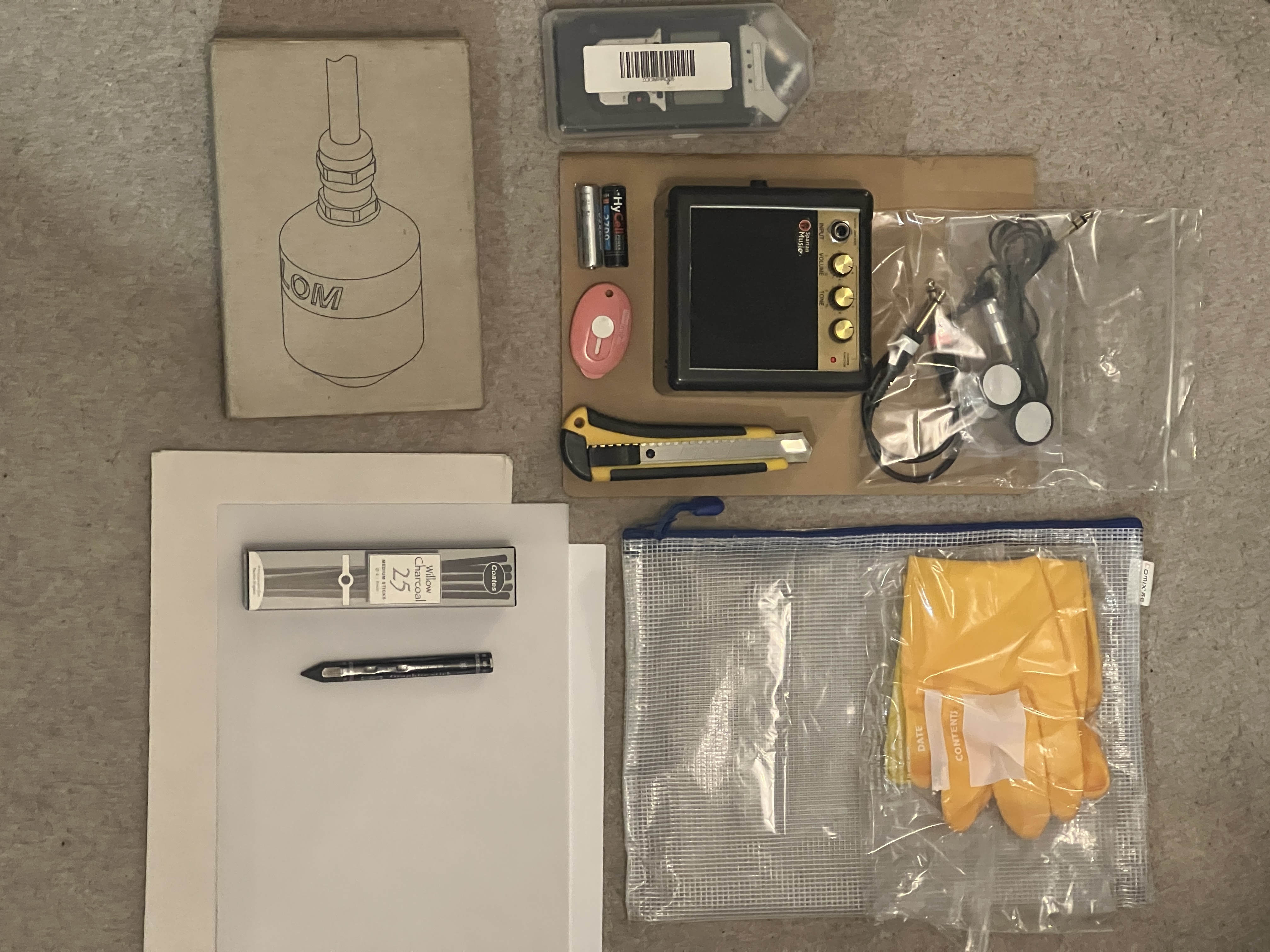
1. 2024/10/19 - Walthamstow Wetland
Before heading out for my field research, I prepared a selection of tools and packed them into a small trolley for easy transport. These included a Zoom Recorder, LOM Geofón, a camera, a charcoal pencil, A4 paper, tracing paper, gloves, a speaker, scissors, a file bag, and a folder.
After exiting Blackhorse Road Underground Station, I walked towards Walthamstow Wetlands. The bustling sounds along the way gradually diminished in layers, creating a sense of transition. I tried recording the sounds during the walk from the station to the wetlands—car engines, construction noises, voices, and the wind. It wasn’t until I got closer to the wetlands that the bird calls became more distinct. However, there is a railway track separating the wetlands from the road. Standing by the railings outside the wetland reserve, I could still feel that the noise overshadowed some of the natural sounds.
Before even entering the reserve, I was drawn to the railway fences and the surrounding area. There was a large spider web at the junction of a wall and a fence. Every time a train roared past, the web would sway slightly in the wind, and a large spider was hanging on the web, occasionally moving across it.
I used the Zoom Recorder and LOM Geofón to capture the sounds of the fence and the surrounding area. I used Geofón (A sensitive omnidirectional geophone) as a more sensitive contact microphone to hear the internal vibrations of the materials.
With A4-sized tracing paper, I made rubbings of the textures of the wall and fence while also recording the accompanying sounds. I used charcoal to trace along the surface of the human industrial product onto paper, generating a ‘notation’ that records the interactive sounds of replicating the surface, as well as the sounds of the surroundings.
Using the ‘scar instrument’ bow I had created earlier, I interacted with the material of the fence, producing vibrating sounds. Looking at the non-humans in front of me, I drew their shapes on the material (human industrial product) with the bow like I was painting (thus making sounds and recording them). And I tried to observe if it would affect the spider. Of course, the spider quickly disappeared before my eyes, leaving behind its large web.
And according to the map, I marked the location of listening and sound walking, longitude and latitude coordinates, time, and drew out the surrounding environmental characteristics to make the Soundwalking Map. Based on the sounds I listened to, I recorded them with a Zoom recorder and also visualised the volume and range of the sounds in these specific sites to make the Sound Map during the fieldwork.
During the fieldwork and field Recording, I used Zoom Recorder to record sound - industrial noise and original non-human voices. I tried to mix sounds together (Internal vibrations and ambient sounds) and record the exact internal sounds with Geofón, and record the changes. At the same time, I wrote down the sound information of all the places/sites:
Site 1: Human Intervention: Cars, trains, sidewalks; Non-Humans: Spiders, insects, trees, flowers, leaves, moss, wind.
Site 2: Human Intervention: Railings, fence, traffic lights, cars, horns, gates, footsteps, bricks; Non-Humans: Leaves, rivers, ants, plants, cirrus, wind.
Site 3: Human Intervention: Plank road, footstep, parking lot; Non-Humans: Wood blocks, puddles, river, wind, rain, leaves, grass, foxes, birds.
Site 4: Human Intervention: Iron sheet, machine, cement, train, arch of the bridge, mirror; Non-Humans: Leaves, grass, rain, wind, foxes, birds, stone.
Site 5: Human Intervention: Abandoned machinery, turntable, wood pile, railings, houses, artificial beehives, stalls, bicycle; Non-Humans: Small fruits, seeds, trees, leaves, grass, wind, rain, moss.
Site 6: Human Intervention: Artificial equipment, fences, riverbanks, lifebuoys, warning signs; Non-Humans: Lake, river, waves, water, ducks, birds, rain, fish, moss, grass, air bubble.
Site 7: Human Intervention: River cleaning machine, buildings, handrail, chain, screw; Non-Humans: Weeds, river, ducks, birds, grass, trees, leaves, rain.
The river cleaning machine at Site 7, in my opinion, is a quintessential representation of industrial intervention in nature within this wetland. This large, man-made machine produces noise while operating automatically, which to some extent deters nearby wildlife, such as ducks, from approaching. The machine’s purpose is to clear leaves and other debris from the river to prevent blockages, which might be considered a form of human-led environmental protection. However, the use of an industrial automated machine, likely for efficiency and regularity, still impacts the surrounding environment, particularly in terms of noise.
I was trying to look for notation/symbolic things in the environment, focusing on industrial products (human intervention) and non-humans. The linear materials, such as railings and telephone poles/wires, may be isomorphic to the lines of musical notation.
In addition, leaves or industrial products randomly fall on various places on the fence. Walking along the fence, I found there were naturally fallen leaves as well as artificial products such as ropes. The up and down positions of different materials are like symbols in grids and/or notes on lines.
Later, I tried to do some visual experiments, such as extracting possible visual symbol information in the sites (damaged by industrialisation), considering the role of sound and symbol in the soundscapes of wilderness (and city) under the human intervention of industrialisation. And I found linear materials, such as railings and telephone poles/wires, may be isomorphic to the lines of musical notation. Such as Yoshinori Mizutani's work, flocks of cormorants occupy overhead power lines to form musical notes in the sky. The part blocked by the railing can be left blank, so the visual lines or sections are discontinuous. Also, the parts of non-humans that come into contact with the ground, such as the asphalt on tree roots, shape or influence the state or form of the tree's contact with the ground. I tried to extract symbolic information about the impact on non-humans from it. In the future, I may want to do some extended output around these visual experiments.
Before heading out for my field research, I prepared a selection of tools and packed them into a small trolley for easy transport. These included a Zoom Recorder, LOM Geofón, a camera, a charcoal pencil, A4 paper, tracing paper, gloves, a speaker, scissors, a file bag, and a folder.
After exiting Blackhorse Road Underground Station, I walked towards Walthamstow Wetlands. The bustling sounds along the way gradually diminished in layers, creating a sense of transition. I tried recording the sounds during the walk from the station to the wetlands—car engines, construction noises, voices, and the wind. It wasn’t until I got closer to the wetlands that the bird calls became more distinct. However, there is a railway track separating the wetlands from the road. Standing by the railings outside the wetland reserve, I could still feel that the noise overshadowed some of the natural sounds.
Before even entering the reserve, I was drawn to the railway fences and the surrounding area. There was a large spider web at the junction of a wall and a fence. Every time a train roared past, the web would sway slightly in the wind, and a large spider was hanging on the web, occasionally moving across it.
I used the Zoom Recorder and LOM Geofón to capture the sounds of the fence and the surrounding area. I used Geofón (A sensitive omnidirectional geophone) as a more sensitive contact microphone to hear the internal vibrations of the materials.
With A4-sized tracing paper, I made rubbings of the textures of the wall and fence while also recording the accompanying sounds. I used charcoal to trace along the surface of the human industrial product onto paper, generating a ‘notation’ that records the interactive sounds of replicating the surface, as well as the sounds of the surroundings.
Using the ‘scar instrument’ bow I had created earlier, I interacted with the material of the fence, producing vibrating sounds. Looking at the non-humans in front of me, I drew their shapes on the material (human industrial product) with the bow like I was painting (thus making sounds and recording them). And I tried to observe if it would affect the spider. Of course, the spider quickly disappeared before my eyes, leaving behind its large web.
And according to the map, I marked the location of listening and sound walking, longitude and latitude coordinates, time, and drew out the surrounding environmental characteristics to make the Soundwalking Map. Based on the sounds I listened to, I recorded them with a Zoom recorder and also visualised the volume and range of the sounds in these specific sites to make the Sound Map during the fieldwork.
During the fieldwork and field Recording, I used Zoom Recorder to record sound - industrial noise and original non-human voices. I tried to mix sounds together (Internal vibrations and ambient sounds) and record the exact internal sounds with Geofón, and record the changes. At the same time, I wrote down the sound information of all the places/sites:
Site 1: Human Intervention: Cars, trains, sidewalks; Non-Humans: Spiders, insects, trees, flowers, leaves, moss, wind.
Site 2: Human Intervention: Railings, fence, traffic lights, cars, horns, gates, footsteps, bricks; Non-Humans: Leaves, rivers, ants, plants, cirrus, wind.
Site 3: Human Intervention: Plank road, footstep, parking lot; Non-Humans: Wood blocks, puddles, river, wind, rain, leaves, grass, foxes, birds.
Site 4: Human Intervention: Iron sheet, machine, cement, train, arch of the bridge, mirror; Non-Humans: Leaves, grass, rain, wind, foxes, birds, stone.
Site 5: Human Intervention: Abandoned machinery, turntable, wood pile, railings, houses, artificial beehives, stalls, bicycle; Non-Humans: Small fruits, seeds, trees, leaves, grass, wind, rain, moss.
Site 6: Human Intervention: Artificial equipment, fences, riverbanks, lifebuoys, warning signs; Non-Humans: Lake, river, waves, water, ducks, birds, rain, fish, moss, grass, air bubble.
Site 7: Human Intervention: River cleaning machine, buildings, handrail, chain, screw; Non-Humans: Weeds, river, ducks, birds, grass, trees, leaves, rain.
The river cleaning machine at Site 7, in my opinion, is a quintessential representation of industrial intervention in nature within this wetland. This large, man-made machine produces noise while operating automatically, which to some extent deters nearby wildlife, such as ducks, from approaching. The machine’s purpose is to clear leaves and other debris from the river to prevent blockages, which might be considered a form of human-led environmental protection. However, the use of an industrial automated machine, likely for efficiency and regularity, still impacts the surrounding environment, particularly in terms of noise.
I was trying to look for notation/symbolic things in the environment, focusing on industrial products (human intervention) and non-humans. The linear materials, such as railings and telephone poles/wires, may be isomorphic to the lines of musical notation.
In addition, leaves or industrial products randomly fall on various places on the fence. Walking along the fence, I found there were naturally fallen leaves as well as artificial products such as ropes. The up and down positions of different materials are like symbols in grids and/or notes on lines.
Later, I tried to do some visual experiments, such as extracting possible visual symbol information in the sites (damaged by industrialisation), considering the role of sound and symbol in the soundscapes of wilderness (and city) under the human intervention of industrialisation. And I found linear materials, such as railings and telephone poles/wires, may be isomorphic to the lines of musical notation. Such as Yoshinori Mizutani's work, flocks of cormorants occupy overhead power lines to form musical notes in the sky. The part blocked by the railing can be left blank, so the visual lines or sections are discontinuous. Also, the parts of non-humans that come into contact with the ground, such as the asphalt on tree roots, shape or influence the state or form of the tree's contact with the ground. I tried to extract symbolic information about the impact on non-humans from it. In the future, I may want to do some extended output around these visual experiments.
︎︎︎BACK
liangchennn.sui@gmail.com;slcbeihang@163.com Liangchen Sui ©️2025 London, Shanghai